The Story
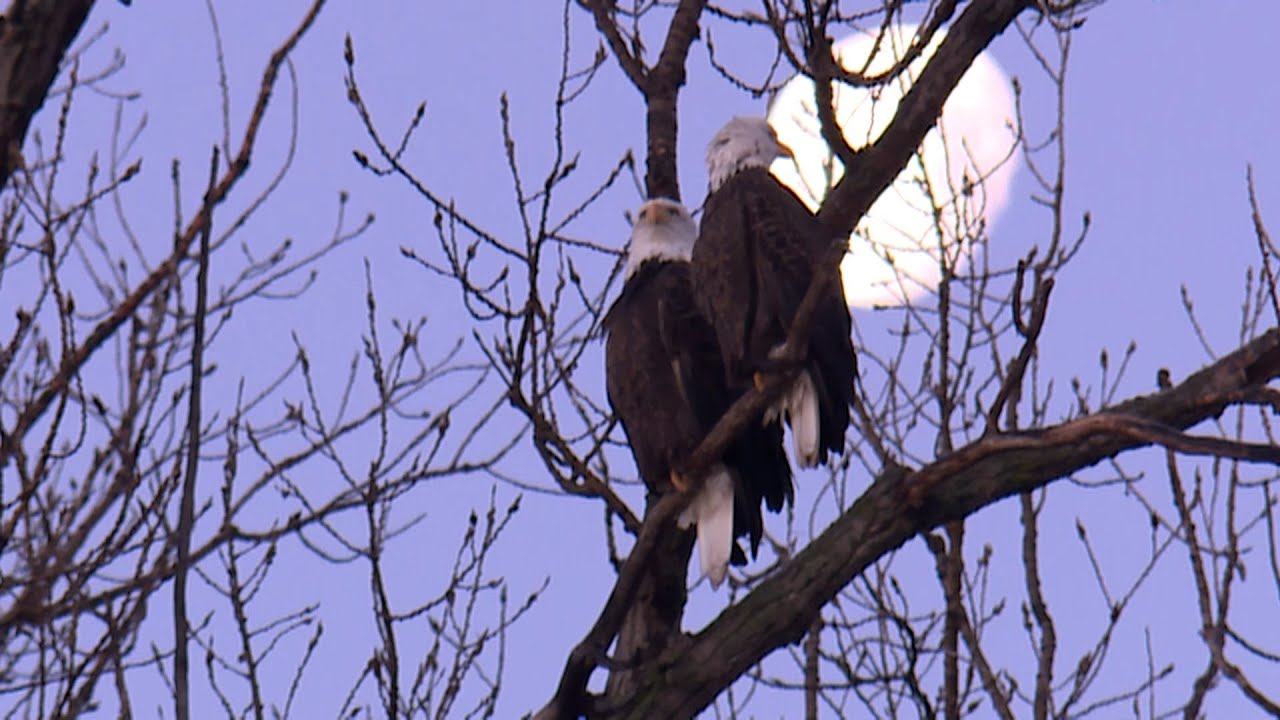
Bald eagles fill this short clip from Loess Bluffs Wildlife Refuge, just north of Kansas City: birds crossing a dusky purple sky, white-headed adults paired on bare limbs, brown young ones perched around a huge stick nest under hard blue sky. On December 30 the refuge set a new record, with more than 1,000 bald eagles spotted.
A snowy head, neck and tail on a dark brown body mark an adult, and that full white head and tail arrives at about five years. No other adult eagle wears both a white head and a white tail. The young are dark brown with whitish mottling in the wings and tail and a black bill, and the clip has plenty of them: one sits close enough to show pale flecks across its back, and two more share a treetop near a pair of adults.
In one bare tree, three brown young eagles perch around a stick nest far bigger than any of them. Bald eagle nests are generally 4 to 5 feet wide and 2 to 4 feet deep, and they are added to every year until some reach 10 feet across.
In winter bald eagles gather where open water and easy food meet, and the Mississippi River holds the Midwest's highest concentration, with open water at locks, dams and power plants.
Bald eagles roost communally, especially in winter, in groups that can reach 400 birds. More than 200 winter at Blackwater in Maryland, and Reelfoot Lake in Tennessee draws more than 200 at a February peak. Set beside that, a single-day tally past 1,000 is an outsized figure.
By 1963 only 417 nesting pairs were known in the lower 48 states, their eggshells thinned by DDT. Bans on the pesticide and legal protection turned that around, and on June 28, 2007 the bald eagle's removal from the list of threatened and endangered species was announced. Late in the clip two birds wheel together against a flat gray sky, wings wide, one banking under the other.