Bald eagle field guide
Field Guide
| Common name | Bald eagle |
|---|---|
| Scientific name | Haliaeetus leucocephalus |
| Family | Accipitridae (hawks, eagles and kites) |
| Size | 79 to 94 cm long; females generally somewhat larger than males.Animal Diversity Web, University of Michigan · NatureServe · Smithsonian's National Zoo & Conservation Biology Institute |
| Weight | 6.5 to 14 pounds (3 to 6.5 kilograms); average 4.3 kg.Smithsonian's National Zoo & Conservation Biology Institute · Animal Diversity Web, University of Michigan |
| Wingspan | 178 to 229 cm; up to 8.5 feet (2.6 meters).Animal Diversity Web, University of Michigan · Smithsonian's National Zoo & Conservation Biology Institute |
| Lifespan | Typically 15-20 years in the wild (oldest known wild bird 28); up to about 30 years in the wild per USFWS; one captive bird reportedly lived 47 years.Animal Diversity Web, University of Michigan · U.S. Fish & Wildlife Service |
| Diet | Mainly fish such as salmon, herring, catfish and carp; also waterfowl, small mammals, turtles, snakes and carrion.National Audubon Society · U.S. Fish & Wildlife Service |
| Active when | Diurnal (active by day); most populations, especially northern ones, migrate to milder climates each year.Animal Diversity Web, University of Michigan |
| Range | Throughout North America near large water, concentrated in Florida, Alaska, the Pacific Northwest and near some Midwest rivers and lakes; Alaska estimated at 70,000 (2020).Animal Diversity Web, University of Michigan · Alaska Department of Fish and Game |
| Conservation status | IUCN Red List: Least Concern; NatureServe Global Rank G5 (secure, reviewed 2016-04-08). Removed from the US endangered species list in 2007.NatureServe · Animal Diversity Web, University of Michigan · U.S. Fish & Wildlife Service |
Field Marks
- Adults: snowy white head, neck and tail on a dark brown body, with a large yellow bill, yellow feet and pale yellow eyes.Smithsonian's National Zoo & Conservation Biology Institute · NatureServe
- Adults are the only eagles with both a white head and a white tail; proportionately larger head and bill than a golden eagle.NatureServe
- Juveniles are dark brown with whitish mottling in the wings and tail, and a black beak rather than yellow.National Audubon Society · Alaska Department of Fish and Game
- Young birds can be told in flight by a white diagonal strip under the wing and a spot in the 'wingpit'; immature golden eagles show white only at the base of primaries and tail.Iowa Department of Natural Resources · NatureServe
- Full white head and tail arrive at about five years of age (by 5.5 years per Audubon).U.S. National Park Service · National Audubon Society
Habitat
- Often next to water along coasts, rivers or large lakes, in forest with openings or edges for foraging.National Audubon Society
- In many areas found within 3 km of a water source; breeding habitat is most commonly within 4 km of coasts, bays, rivers, lakes or reservoirs.Animal Diversity Web, University of Michigan · NatureServe
- Also uses swamps in Florida, conifer forest edges in southeastern Alaska, treeless islands in the Aleutians and desert rivers in Arizona.National Audubon Society
- Nests in tall trees near water, up to 180 ft or more above ground; in southern Florida in mangroves; in treeless areas on cliffs or the ground.National Audubon Society · Animal Diversity Web, University of Michigan
- Nest trees vary by region, including pine, spruce, fir, cottonwood, poplar, willow, sycamore, oak and beech.NatureServe
Behavior
- Hunts from high perches, swooping to take prey in its talons, or cruises low over water and land.National Audubon Society
- Opportunistic: scavenges carrion and pirates food from other eagles and other raptors.National Audubon Society · Animal Diversity Web, University of Michigan
- Voice is weak and high-pitched: squeaky cackling, thin squeals and a series of short 'kaks'.National Audubon Society · U.S. National Park Service
- The 'screaming' call often dubbed over bald eagles in film is actually a red-tailed hawk call.Smithsonian's National Zoo & Conservation Biology Institute
- Roosts communally, especially in winter, in groups of up to 400 birds.NatureServe · Animal Diversity Web, University of Michigan
- Some pairs stay together many years but will pair again if a mate is lost; first breeding at about 4-5 years.U.S. National Park Service · National Audubon Society
- Both parents build the nest, incubate and care for the young; nests are added to every year.Minnesota Department of Natural Resources
- Nests are generally 4 to 5 feet wide and 2 to 4 feet deep, can reach 10 feet across and weigh thousands of pounds; Alaska calls it the largest nest of any North American bird.U.S. Fish & Wildlife Service · Alaska Department of Fish and Game
- Egg timing varies by region: incubation begins in October in Florida, laying generally in December in South Carolina, usually January per Minnesota DNR, late April in Alaska.Animal Diversity Web, University of Michigan · South Carolina Department of Natural Resources · Minnesota Department of Natural Resources · Alaska Department of Fish and Game
- Lays 1-3 eggs, usually 2; incubation by both parents lasts 34-36 days.National Audubon Society · NatureServe
- Young leave the nest at 8-14 weeks; Minnesota DNR says young begin to fly at three months, late May through early July.National Audubon Society · Minnesota Department of Natural Resources
- The largest chick gets the most food and only the largest may survive when prey is scarce; the second-hatched chick often dies.National Audubon Society · NatureServe
- Eggs and young are taken by ravens, crows, magpies, gulls, black bears, raccoons and bobcats; adults are rarely preyed on.Animal Diversity Web, University of Michigan
- Avoids disturbed foraging areas: feeding drops by up to 35% when people are present.Animal Diversity Web, University of Michigan
Winter
- The Mississippi River holds the Midwest's highest concentration of eagles in winter, with open water at locks, dams and power plants where eagles fish.Iowa Department of Natural Resources · U.S. Fish & Wildlife Service
- Eagles may concentrate below hydroelectric dams to forage on injured fish; on the Mississippi in winter they fish open water below dams or perch on ice shelves.South Carolina Department of Natural Resources · U.S. National Park Service
- Gathers where salmon spawn: over 3,000 may congregate in Alaska's Chilkat Valley in late fall and early winter to feed on spawned-out salmon.Smithsonian's National Zoo & Conservation Biology Institute · Alaska Department of Fish and Game
- Northern interior breeders (north of 40°N) migrate south August-January and return January-March.National Audubon Society
- Some refuges host hundreds in winter: more than 200 winter at Blackwater, Maryland, and more than 200 at Reelfoot Lake, Tennessee, where numbers peak in February.U.S. Fish & Wildlife Service
Questions
How big is a bald eagle?
It is 79 to 94 cm long with a wingspan of 178 to 229 cm. It weighs 6.5 to 14 pounds, and females are generally larger than males.Animal Diversity Web, University of Michigan · Smithsonian's National Zoo & Conservation Biology Institute
Why is the eagle brown with no white head?
It is a young bird. Bald eagles do not get the full white head and tail until about four or five years old.Smithsonian's National Zoo & Conservation Biology Institute · U.S. National Park Service
What do bald eagles eat?
Fish are the staple. They also take waterfowl, shorebirds, turtles, rabbits, snakes and other small animals, and eat carrion.U.S. Fish & Wildlife Service
Why do so many eagles gather at one river in winter?
They gather where open water and easy food meet. Locks, dams and power plants keep the Mississippi from freezing and stun fish, and in Alaska thousands feed on spawned-out salmon.Iowa Department of Natural Resources · Alaska Department of Fish and Game
How big is a bald eagle nest?
Nests are generally 4 to 5 feet wide and 2 to 4 feet deep. Reused and enlarged yearly, they can reach 10 feet across and weigh thousands of pounds.U.S. Fish & Wildlife Service
When do eagles on nest cams lay eggs and hatch?
Minnesota DNR says eggs usually come in January, and incubation lasts about 35 days. The Minnesota DNR EagleCam follows a pair through the breeding season.Minnesota Department of Natural Resources · Minnesota Department of Natural Resources
What sound does a bald eagle make?
Weak, high-pitched squeaky cackling and thin squeals. The scream heard in movies is a red-tailed hawk.National Audubon Society · Smithsonian's National Zoo & Conservation Biology Institute
Were bald eagles endangered?
DDT thinned their eggshells, and by 1963 only 417 nesting pairs were known in the lower 48 states. After DDT bans and protection they recovered; removal from the list was announced June 28, 2007.U.S. Fish & Wildlife Service
How many bald eagles are there now?
The lower-48 estimate from 2018-2019 data is 316,700 individuals, including 71,467 breeding pairs. Alaska was estimated at 70,000 bald eagles in 2020.U.S. Fish & Wildlife Service · Alaska Department of Fish and Game
How close can I get to an eagle?
Iowa DNR advises staying no closer than 400 yards from a perched eagle. Eagles are also protected by the Bald and Golden Eagle Protection Act.Iowa Department of Natural Resources · U.S. Fish & Wildlife Service
Clips
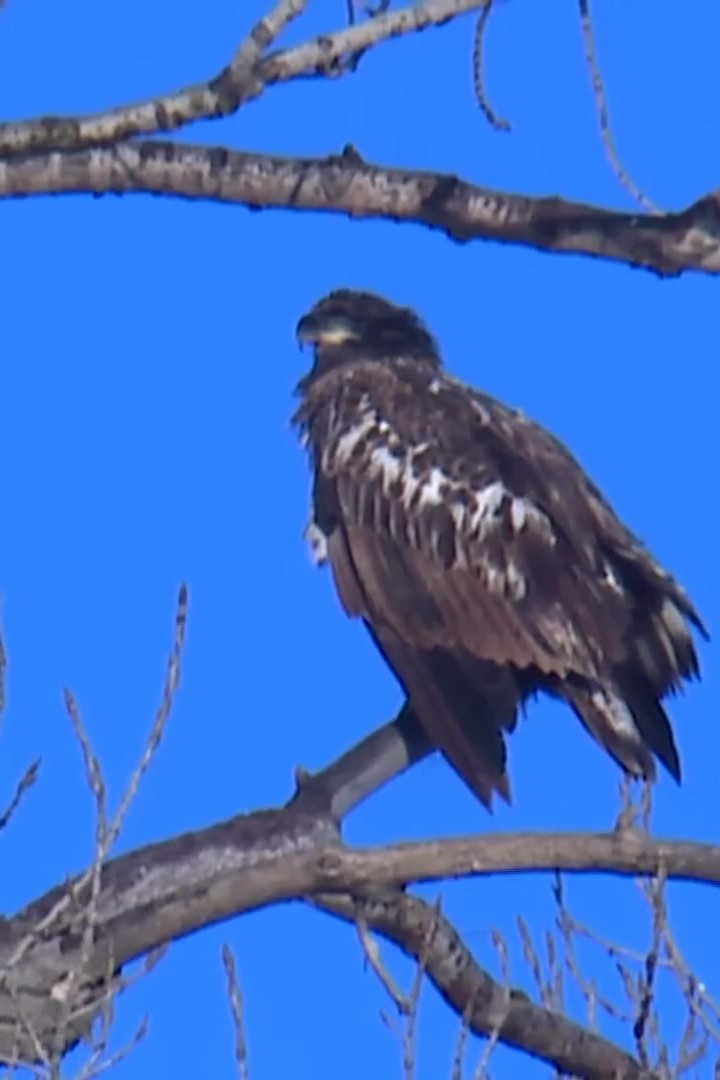 Two adult bald eagles share a bare winter limb
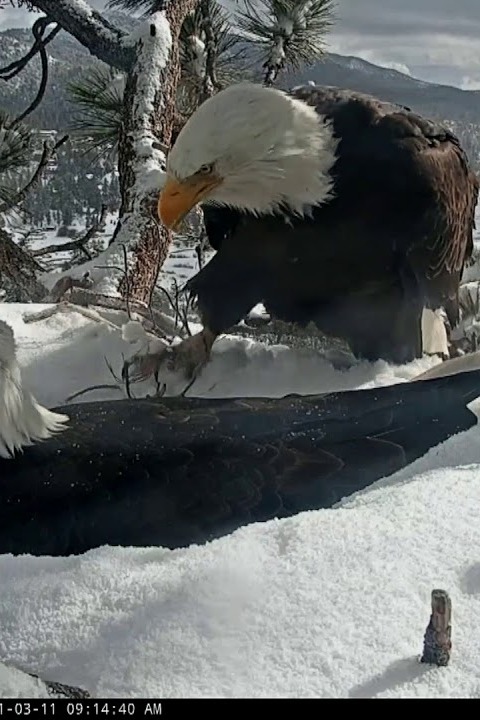 Bald eagles swap shifts on a snowy nest
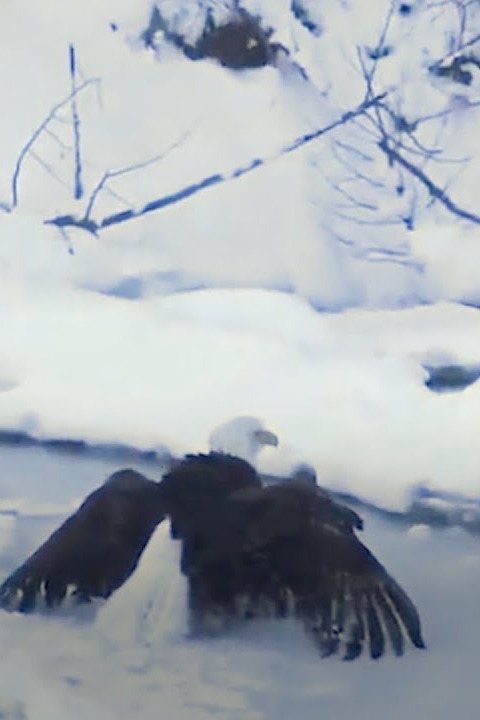 Bald eagle frozen to the ice by its tail
Two adults share one bare limb at Loess Bluffs Wildlife Refuge north of Kansas City, where a December 30 count topped 1,000 bald eagles.
At Big Bear Lake, California, one bald eagle lays a stick on its snow-buried mate's tail, and moments later the pair trade places on two eggs.
An adult bald eagle frozen to a lake by a ball of ice on its tail is thawed loose with warm water and released before a crowd.
Sources
- Bald Eagle (Guide to North American Birds), National Audubon Society
- Bald eagle Haliaeetus leucocephalus, U.S. Fish & Wildlife Service
- Haliaeetus leucocephalus (bald eagle), Animal Diversity Web, University of Michigan
- Bald Eagle, Smithsonian's National Zoo & Conservation Biology Institute
- Haliaeetus leucocephalus - Bald Eagle (NatureServe Explorer), NatureServe
- South Carolina's Bald Eagles - Biology, South Carolina Department of Natural Resources
- Frequently asked questions about the EagleCam and bald eagles, Minnesota Department of Natural Resources
- DNR EagleCam, Minnesota Department of Natural Resources
- Bald Eagle, Iowa Department of Natural Resources
- Winter is Prime Time for Viewing Eagles on National Wildlife Refuges, U.S. Fish & Wildlife Service
- Bald Eagle - Mississippi National River & Recreation Area, U.S. National Park Service
- Bald Eagle Species Profile, Alaska Department of Fish and Game