The Story
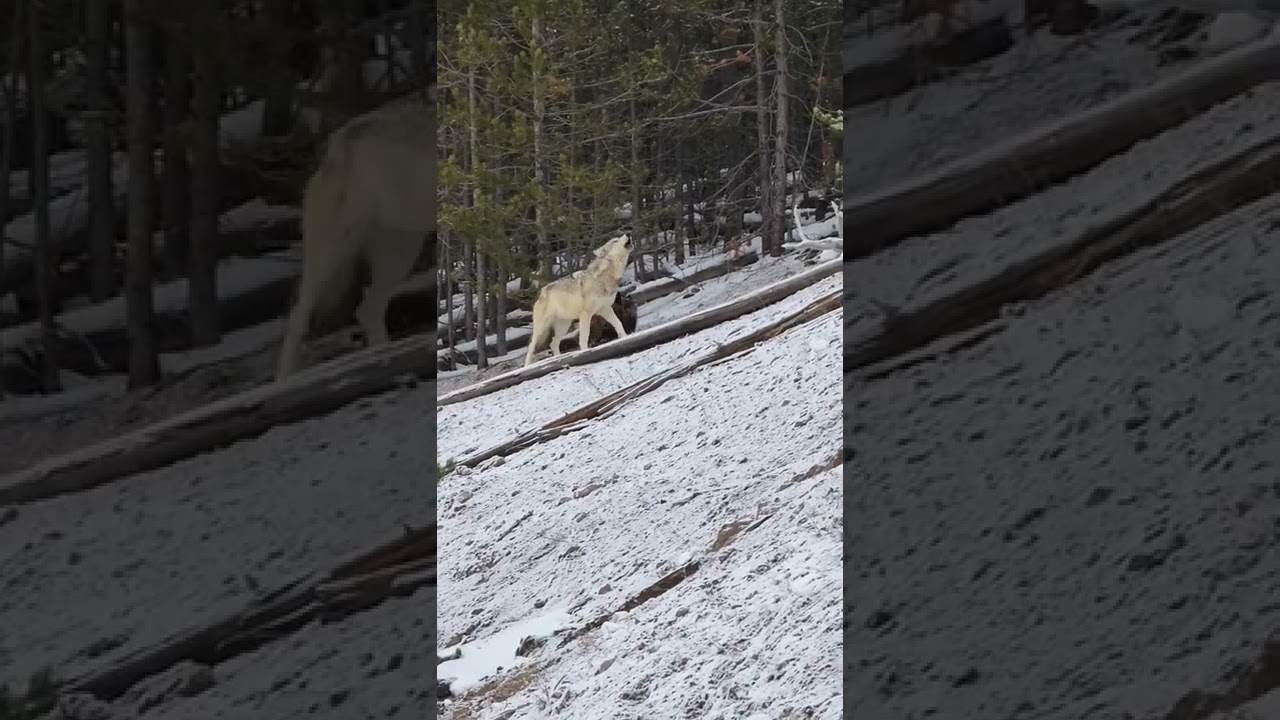
Head thrown back, muzzle pointed straight at the sky, a pale gray wolf howls from a snowy hillside in Yellowstone National Park. Behind it, half lost against the trees, stands a darker wolf.
It is a chilly dawn, and the pair belong to the Wapiti Pack. The filmer, one of a small group of people out early, describes the wolves going about the business of organizing a hunt around them. For a photographer who had waited years for this encounter, being treated as part of the furniture is the best possible review.
The howl is the wolf's long-distance line. In forest it carries about 11 kilometers, roughly 6.6 miles, and in open country about 16 kilometers. It has two broad jobs. A defensive howl keeps the pack together and strangers away. A social howl helps wolves find one another and rally. Nothing in the clip settles which one this is. A pack pulling itself together for a hunt would fit the second, but the wolf does not explain itself.
The coat is the other thing worth a long look. Wolf coats are often buff-tan grizzled with gray and black. In Yellowstone, gray and black wolves turn up in roughly equal numbers and white ones are rare, so a near-white animal howling beside a dark one puts both ends of the park's palette on one slope.
Timing matters too. Wolves are mainly nocturnal, and their movements are usually at night; this pack is working out a hunt as the light comes up. In Yellowstone winters, elk make up over 96 percent of the wolves' prey, and each wolf takes about 18 to 22 elk a year.
A pack is a family: a breeding pair, their pups, perhaps last year's young, sometimes an older wolf. Yellowstone packs average close to ten animals. Two wolves on a hillside are a fraction of a household, and a howl is built to reach the rest.