My Crittercam
My Crittercam › Mule deer

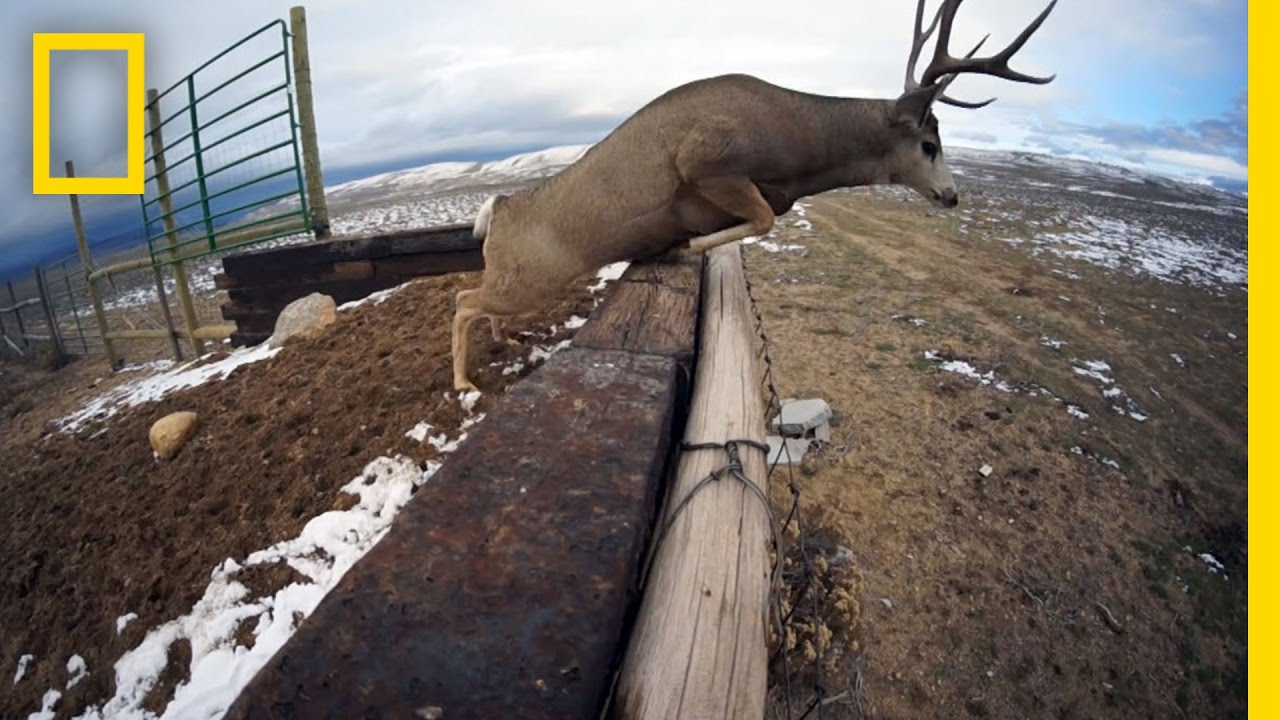
Mule deer buck clears a fence on a 150-mile trek

The front half of a mule deer buck with forked antlers leaps out over a wire-lashed wooden fence rail strung with barbed wire, above brown flats patched with snow under a cloudy sky.

Footage: National Geographic · 4:30 · uploaded April 24, 2014
Written by My Crittercam · published November 6, 2026

The Story

A mule deer buck sails over a wire-wrapped fence rail, a foreleg folded under him and forked antlers high, past a camera fixed on the rail itself. Beyond him, snow lies in patches across open Wyoming flats.

This herd was supposed to stay put. Biologists began tracking mule deer in Wyoming's Red Desert expecting a resident herd, one that lived in the same country year-round. GPS tracking said otherwise. Most of the deer walk some 150 miles north to the mountain ranges of northwest Wyoming, across public and private land, and the researchers had no idea.

It has a name now. Red Desert to Hoback runs 150 miles one way, from desert winter ranges to the mountain slopes around the Hoback Basin, a 300-mile round trip. The deer spend four months of every year on the move, and in 2016 one doe, Deer 255, went 242 miles from the Red Desert to Island Park, Idaho.

Why go that far? Mule deer shift between higher summer ranges and lower winter ranges, and this long link is thought to give Red Desert deer the best fat gain over summer and the best fat conservation through winter. Long, snowy winters drain an adult's reserves, and month after month of belly-deep snow can starve a fawn that lacks them.

The country between is not open. Three highways cut the route, plus more than 100 fences, river crossings and several reservoirs. Cameras set at the outlets of a chain of lakes catch the herd swimming through, and the footage comes back full of vocalizations. The deer have opinions about the water.

None of it is improvised. The route passes from mother to offspring, generation after generation, so the deer use the same path year after year. Fawns usually stay with the doe through their first full year, long enough to walk it at her side. The buck on the fence is following that inherited line, and the barbed wire is only the newest thing in his way.
Field Guide

A mule deer buck clears a wire-wrapped fence rail in western Wyoming, one of more than 100 fences on a 150-mile migration out of the Red Desert. Full field guide for the Mule deer

Common nameMule deer
Scientific nameOdocoileus hemionus
FamilyCervidae (Deer family)
SizeMales: body length 126 to 168 cm, shoulder height 84 to 106 cm. Females: body length 125 to 156 cm, shoulder height 80 to 100 cm.Animal Diversity Web, University of Michigan
WeightBucks may weigh up to 350 lbs.; does rarely surpass 150 lbs.National Park Service
RangeMost of North America west of the 100th meridian, from 23 degrees to 60 degrees N; in the West from Canada to Mexico.Animal Diversity Web, University of Michigan · National Park Service
DietIntermediate feeder: woody and herbaceous forage in approximate equal proportions, plus acorns, legume seeds and fleshy fruits.Animal Diversity Web, University of Michigan
Active whenCrepuscular; most often seen in the early morning and late evening.National Park Service
LifespanUsually 9 to 11 years in the wild; average lifespan in captivity 22 years.National Wildlife Federation · Animal Diversity Web, University of Michigan
Conservation statusIUCN Red List: Least Concern. NatureServe: G5.Animal Diversity Web, University of Michigan · NatureServe
Cam notes · Camerafixed cameras set along the migration route, here fixed on a fence rail
Cam notes · Time of dayday
Cam notes · Seasonsnow lying in patches
Cam notes · Placewestern Wyoming

Habitat

Behavior

Questions

How far does the Red Desert herd migrate?

The Red Desert to Hoback route runs 150 miles one way, from desert winter ranges to the mountain slopes around the Hoback Basin. In 2016 one doe, Deer 255, went 242 miles from the Red Desert to Island Park, Idaho.Wyoming Migration Initiative, University of Wyoming · University of Wyoming

Why do mule deer migrate instead of staying put?

Mule deer move between higher summer ranges and lower winter ranges, and in Oregon they often travel long distances to escape snow cover. For Red Desert deer, the long route is thought to give the best fat gain in summer and fat conservation in winter.Animal Diversity Web, University of Michigan · USDA Forest Service · University of Wyoming

How long does the migration take?

Deer on the Red Desert to Hoback route spend 4 months of each year migrating. The round trip covers 300 miles.Wyoming Migration Initiative, University of Wyoming

Latest clips