Mule deer field guide
Field Guide
| Common name | Mule deer |
|---|---|
| Scientific name | Odocoileus hemionus |
| Family | Cervidae (Deer family) |
| Size | Males: body length 126 to 168 cm, shoulder height 84 to 106 cm. Females: body length 125 to 156 cm, shoulder height 80 to 100 cm.Animal Diversity Web, University of Michigan |
| Weight | Bucks may weigh up to 350 lbs.; does rarely surpass 150 lbs.National Park Service |
| Lifespan | Usually 9 to 11 years in the wild; average lifespan in captivity 22 years.National Wildlife Federation · Animal Diversity Web, University of Michigan |
| Diet | Intermediate feeder: woody and herbaceous forage in approximate equal proportions, plus acorns, legume seeds and fleshy fruits.Animal Diversity Web, University of Michigan |
| Active when | Crepuscular; most often seen in the early morning and late evening.National Park Service |
| Range | Most of North America west of the 100th meridian, from 23 degrees to 60 degrees N; in the West from Canada to Mexico.Animal Diversity Web, University of Michigan · National Park Service |
| Conservation status | IUCN Red List: Least Concern. NatureServe: G5.Animal Diversity Web, University of Michigan · NatureServe |
Field Marks
- Large ears, about three-fourths the length of the head; named for them.National Wildlife Federation · National Park Service
- Tail is thin and black-tipped, compared with the white-tailed deer.National Park Service · National Park Service
- The white tails of most mule deer end in a tuft of black hairs, or less commonly in a thin tuft of white hairs.Animal Diversity Web, University of Michigan
- Antlers are bifurcated: the tines fork and multiply from the main beam, a second tine forking into a 'Y'.National Park Service · National Park Service
- Ears are lighter in color on the inside.National Park Service
- When startled, moves in stiff-legged jumps with all four feet hitting the ground together (stotting).National Park Service
Habitat
- Found in desert or dune, savanna or grassland, chaparral, forest and mountains.Animal Diversity Web, University of Michigan
- Adapted to arid, rocky environments; found west of the Missouri River, especially in the Rocky Mountain region.National Wildlife Federation
- Seasonal movements involve migrations from higher elevations (summer ranges) to lower winter ranges.Animal Diversity Web, University of Michigan
- In Oregon, mule deer migrate, often long distances, to lower elevations to escape or minimize exposure to snow cover.USDA Forest Service
- In western Colorado, shrinking habitat due to development, including increased oil and gas drilling, is a likely contributor to mule deer declines.National Wildlife Federation
Behavior
- Stotting, a series of forward jumps with all four feet leaving the ground, is believed to help them see over thick vegetation and out-distance predators in rough terrain.National Park Service · National Park Service
- Escapes predators by bounding rapidly uphill or by sudden unpredictable changes in direction.Animal Diversity Web, University of Michigan
- Males can quickly detect and visually track another animal as far as 600 meters.Animal Diversity Web, University of Michigan
- In summer, feeds on tender branch and leaf tips of trees, shrubs, and some grasses.National Park Service
- Females live in clans related by maternal descent; males disperse as individuals or gather in groups of unrelated individuals.Animal Diversity Web, University of Michigan
- Does spend time in a small herd, often with a few other does and their fawns.National Park Service
- Breeding peak occurs mainly from late November through mid-December.Animal Diversity Web, University of Michigan
- Between November and February (depending on the locality), bucks battle for the right to mate.National Wildlife Federation
- During the rut, bucks compete for dominance and breeding rights by locking antlers.National Park Service
- Average gestation length is 204 days; peak birth period is estimated from June 16th to July 6th; common litter size is two.Animal Diversity Web, University of Michigan
- Fawns are spotted at birth and weigh approximately 5.5 pounds (2.5 kilograms); weaned at about 60 or 75 days.National Wildlife Federation
- Fawns usually stay with the doe for the first full year.National Park Service
- Antler growth begins in the spring; late each winter the antlers fall off.National Park Service
- Predators include pumas, coyotes, bobcats, golden eagles, feral dogs, and black bears.Animal Diversity Web, University of Michigan
- Red Desert to Hoback herd: one-way 150 miles from Red Desert winter ranges to the mountain slopes around the Hoback Basin; a 300-mile round trip.Wyoming Migration Initiative, University of Wyoming
- Deer on the Red Desert to Hoback route spend 4 months of each year migrating. In 2016 Deer 255 went 242 miles from the Red Desert to Island Park, Idaho; at the time no deer had migrated such a great distance from winter range to summer range.Wyoming Migration Initiative, University of Wyoming · University of Wyoming
Winter
- In winter, they depend heavily on browse from shrubs and twigs.National Park Service
- Long, snowy winters deplete an adult's fat reserves; slogging through belly-deep snowpack month after month can starve fawns lacking those reserves.NASA Earthdata
- During harsh winters, deer resort to nipping lichen from rock faces or chewing bark off trees.NASA Earthdata
- Human-related disturbance can stress deer and cause them to expend unnecessary energy, which may increase winter mortality.USDA Forest Service
- Long migration linking summer range to low-elevation winter range is thought to give Red Desert deer optimal fat gain over summer and fat conservation during winter.University of Wyoming
Questions
How big is a mule deer?
Bucks stand 3-3.5 feet at the shoulder and may weigh up to 350 lbs. Does average around 3 feet and rarely surpass 150 lbs.National Park Service
How do I tell a mule deer from a white-tailed deer?
Mule deer have large ears and a thin, black-tipped tail. Their antlers fork into a 'Y', and they bound with all four feet together.National Park Service
Why does a mule deer bounce on all four feet?
The gait is called stotting, a series of stiff-legged jumps with all four feet hitting the ground together. It is believed to let the deer see over thick vegetation and out-distance predators in rough terrain.National Park Service
What do mule deer eat?
They are intermediate feeders, eating woody and herbaceous forage in about equal proportions, plus acorns, legume seeds and fleshy fruits. In winter they depend heavily on browse from shrubs and twigs.Animal Diversity Web, University of Michigan · National Park Service
When are mule deer most active?
They are crepuscular feeders. They are most often seen in the early morning and late evening.National Park Service
How far do mule deer migrate?
Deer in Wyoming's Red Desert travel one-way 150 miles to the mountains around the Hoback Basin. In 2016 one doe, Deer 255, went 242 miles from the Red Desert to Island Park, Idaho.Wyoming Migration Initiative, University of Wyoming · University of Wyoming
When is the mule deer rut?
Breeding peaks mainly from late November through mid-December. Bucks compete for breeding rights by locking antlers.Animal Diversity Web, University of Michigan · National Park Service
How many fawns does a doe have?
The common litter size is two; the peak birth period is estimated at June 16th to July 6th. Fawns are spotted and weigh approximately 5.5 pounds at birth.Animal Diversity Web, University of Michigan · National Wildlife Federation
How do mule deer survive deep snow?
They gain fat in summer and fall and move to lower winter ranges. Long, snowy winters drain those reserves, and belly-deep snow can starve fawns.NASA Earthdata · Animal Diversity Web, University of Michigan
What hunts mule deer?
Predators include pumas, coyotes, bobcats, golden eagles, feral dogs, and black bears. Mountain lions rely heavily on robust mule deer populations.Animal Diversity Web, University of Michigan · National Park Service
Clips
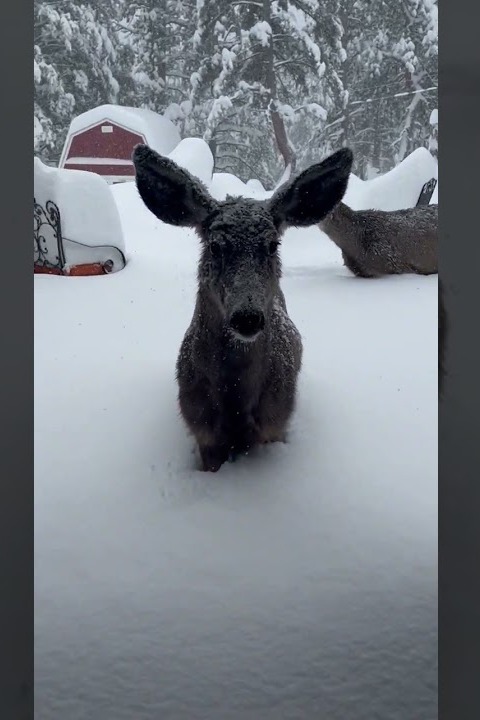
A Colorado mule deer stands chest-deep in a backyard, ears wide, after four feet of snow fell overnight in the March 2024 storm.
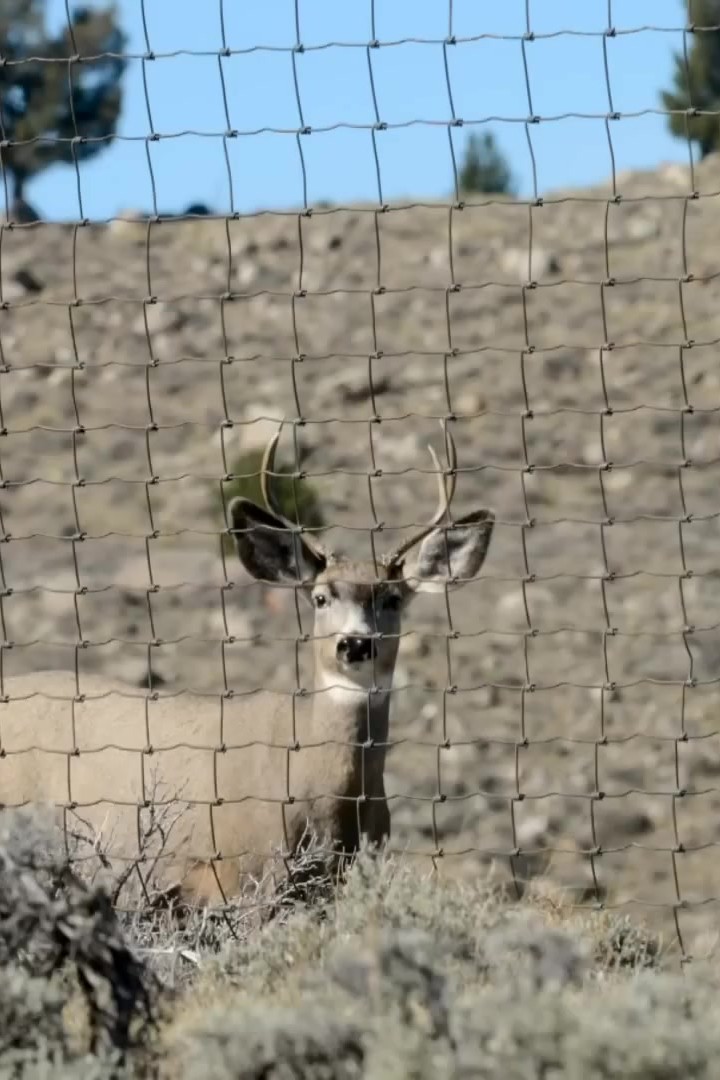
A mule deer buck clears a wire-wrapped fence rail in western Wyoming, one of more than 100 fences on a 150-mile migration out of the Red Desert.
Sources
- Odocoileus hemionus (mule deer), Animal Diversity Web, University of Michigan
- Mule Deer (Odocoileus hemoinus) - Jewel Cave National Monument, National Park Service
- Mule Deer - Theodore Roosevelt National Park, National Park Service
- Mule Deer - Wildlife Guide, National Wildlife Federation
- Red Desert to Hoback Migration Assessment, Wyoming Migration Initiative, University of Wyoming
- After 11 Years, Longest-Migrating Mule Deer Dies in Wyoming's Red Desert, University of Wyoming
- Tracking survival among Idaho's mule deer, NASA Earthdata
- Winter Range Closures - Ochoco National Forest, USDA Forest Service
- Odocoileus hemionus - NatureServe Explorer, NatureServe