My Crittercam
My Crittercam › Gray wolf

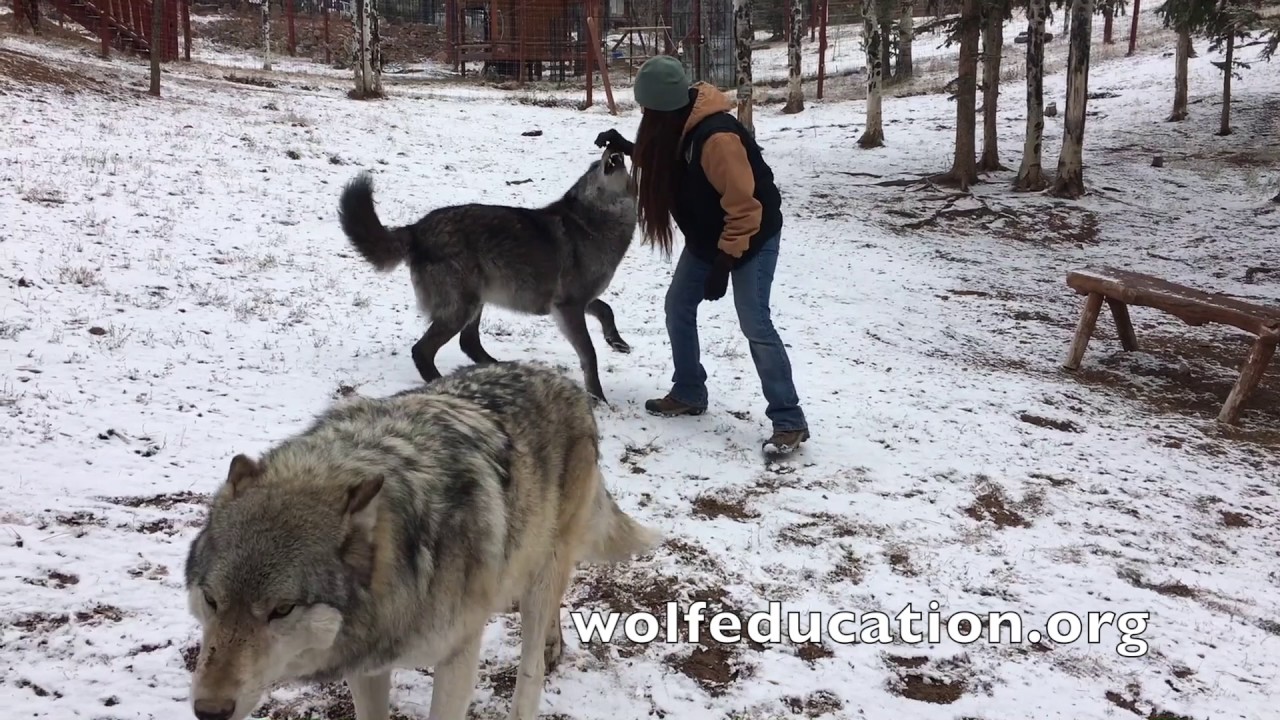
Gray wolf reaches up to its keeper in fresh snow

A dark gray wolf stretches its open muzzle up to the gloved hand of a woman in a green knit hat, black vest over a tan hooded jacket and jeans, the hindquarters of a paler wolf in the left foreground, on snowy ground among pale tree trunks, with part of a website address across the bottom.

Footage: ColoradoWolf&WildlifeCenter · 4:22 · uploaded November 22, 2016
Written by My Crittercam · published November 6, 2026

The Story

Fresh snow covers the Colorado Wolf and Wildlife Center, and a dark gray wolf stretches its muzzle straight up to a keeper's gloved hand. A second wolf, paler and grizzled, ambles toward the lens with its head low, close enough to fill the frame.

Both are gray wolves, Canis lupus, and at this range the field marks read easily. The ears are rounded and relatively short. The muzzle is large and blocky, nothing like the petite, pointed snout of a coyote. The near animal wears the common coat, buff-tan grizzled with gray and black, while its companion is far darker.

The keeper's subject for the day is cold, and how wolves are built for it. Part of the answer lies under the outer coat. Each fall a dense undercoat grows beneath the outer guard hairs; the wolf sheds it by July and starts regrowing it from mid-August. The feet matter too. They are big enough to work like snowshoes, and hair between the toes keeps snow from freezing there.

One of the two is nine years old, and still keen for a romp. That is a respectable age for the species. Gray wolves live up to 13 years in the wild and 15 in captivity, and the average Yellowstone wolf lasts only four to five.

Then the lesson gives way to play, the half of the day the center's own billing promises. A wolf that wants to play dances and bows. Here the keeper is the one doing the inviting. The wolves have the better end of the weather, too. For them a snowy day is the comfortable season and summer here is the hard one. Of the three in the frame, only the keeper came without fur.

In the wild, Minnesota wolves spend most of their fall and winter time sleeping, resting or traveling, and little of it feeding. These two, with fresh snow underfoot and a willing playmate, have other plans.
Field Guide

At the Colorado Wolf and Wildlife Center, a dark gray wolf reaches up to its keeper's gloved hand in fresh snow while a paler wolf pads past. Full field guide for the Gray wolf

Common nameGray wolf
Scientific nameCanis lupus
FamilyCanidae (Dog family)
SizeMales 5 to 6.5 ft long nose to tail tip, females 4.5 to 6 ft; 26 to 32 in at the shoulderU.S. Fish & Wildlife Service (hosted by Montana Fish, Wildlife & Parks)
WeightMales 70 to 115 lb, females 60 to 100 lb; Alaska males occasionally 145 lbU.S. Fish & Wildlife Service (hosted by Montana Fish, Wildlife & Parks)
LifespanUp to 13 years in the wild, 15 in captivity; Yellowstone average 4-5 yearsU.S. Fish & Wildlife Service (hosted by Montana Fish, Wildlife & Parks) · National Park Service, Yellowstone National Park
DietMainly medium and large hoofed mammals. Midwest: mainly white-tailed deer, also moose, beaver and snowshoe hare; Rocky Mountains: elk, deer, moose, bison and beaverU.S. Fish & Wildlife Service (hosted by Montana Fish, Wildlife & Parks) · U.S. Fish & Wildlife Service
Active whenMainly nocturnal; movements are usually at night and cover long distancesNatureServe Explorer · Animal Diversity Web, University of Michigan
RangeLower 48: Minnesota, Wisconsin, Michigan, Montana, Idaho, Wyoming and northern Washington's Cascades; tens of thousands in Canada and AlaskaU.S. Fish & Wildlife Service (hosted by Montana Fish, Wildlife & Parks) · NatureServe Explorer
Conservation statusNatureServe global rank G5. US Endangered Species Act: threatened in Minnesota, endangered in most other lower-48 states; Northern Rocky Mountain population delistedNatureServe Explorer
Cam notes · Time of dayday
Cam notes · Seasonwinter, fresh snow
Cam notes · PlaceColorado Wolf and Wildlife Center, Colorado

Habitat

Behavior

Questions

How do wolves stay warm in the snow?

Each fall a dense undercoat grows beneath the outer guard hairs, and wolves shed it by July before regrowing it from mid-August. Their big feet work like snowshoes, and hair between the toes keeps snow from freezing there.International Wolf Center · International Wolf Center · Animal Diversity Web, University of Michigan

How long do wolves live?

Gray wolves are known to live up to 13 years in the wild and 15 in captivity. In Yellowstone the average is 4-5 years.U.S. Fish & Wildlife Service (hosted by Montana Fish, Wildlife & Parks) · National Park Service, Yellowstone National Park

How big is a gray wolf?

Adult males weigh 70 to 115 pounds and stand 26 to 32 inches at the shoulder. Yellowstone males average 110 pounds and females 90 pounds.U.S. Fish & Wildlife Service (hosted by Montana Fish, Wildlife & Parks) · National Park Service, Yellowstone National Park

Latest clips