My Crittercam
My Crittercam › Gray wolf

Gray wolf pup tries out its first howls

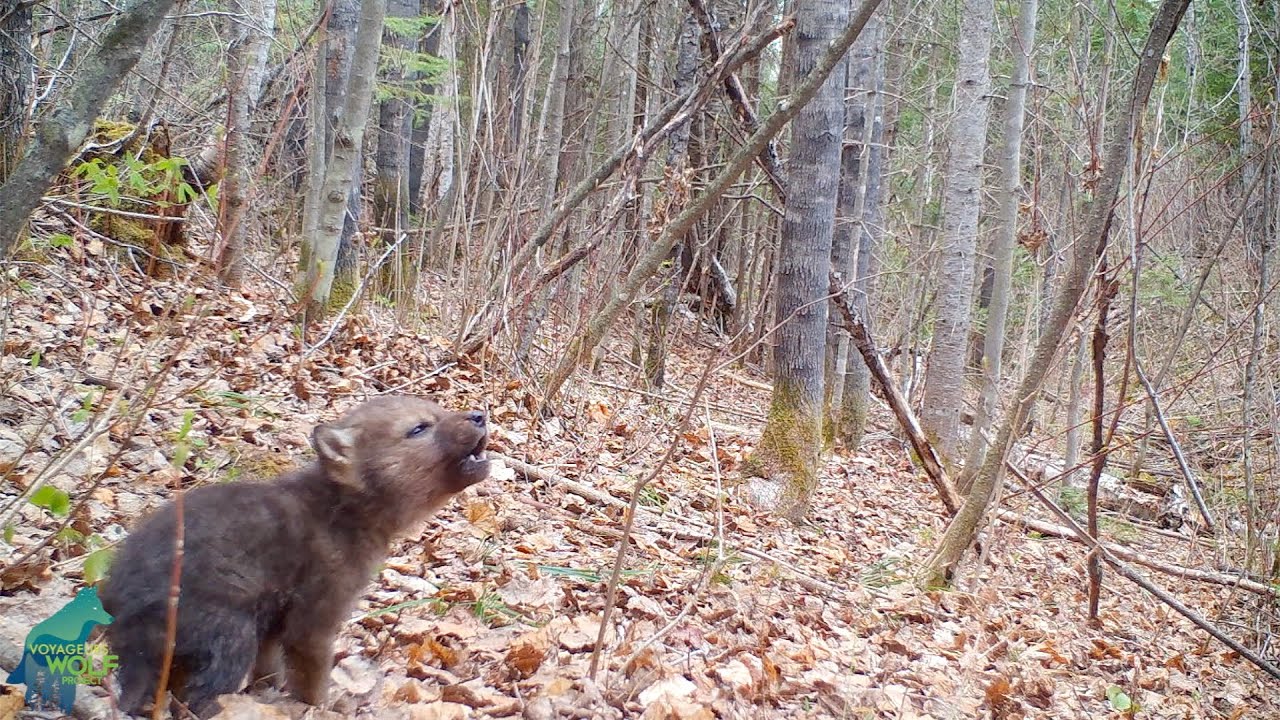
A fuzzy gray-brown wolf pup on dead leaves among bare trunks and a few young conifers tips its head back, eyes half shut and mouth open in a howl.

Footage: Voyageurs Wolf Project · 0:51 · uploaded May 19, 2021
Written by My Crittercam · published November 6, 2026

The Story

A gray wolf pup about four weeks old stands in the dead leaves of a Minnesota forest, points its muzzle at the canopy and howls. It is one of its first, and it comes out far louder than anything that size has a right to produce.

The Voyageurs Wolf Project caught the moment by daylight in the Northwoods of Minnesota. The pup is alone in the frame, a round-headed ball of dusky fuzz with its head tipped back and its mouth open. It does not stop at one. Howl follows howl, pushed hard enough that the sound breaks up in the microphone.

Howling is how wolves talk across distance. In forest a howl carries about 11 kilometers, or 6.6 miles, and wolves put it to many uses. A defensive howl keeps the pack together, warns strangers off and protects pups and kills. A social howl helps wolves find one another, rally, and possibly have fun. Which one this pup has in mind, the footage cannot say.

Wolf pups start life in a den, dug as much as ten feet into well-drained soil or tucked into a hollow log, a cave or an old beaver lodge. At six to eight weeks they are usually moved to rendezvous sites, usually near water. At four weeks, this one has a little way to go.

This pup is still short of weaning, which comes at about six weeks. After that the family does the feeding. A pack is a family group: a breeding male and female, their pups, perhaps last year's young and sometimes older wolves. Adults eat at a kill, come back and bring the meat up when the pups jump and nip at their muzzles. In northern Minnesota summers, they mostly hunt small prey such as beavers and deer fawns.

The recital ends without ceremony. The pup stops, jumps up and dashes off with its tail wagging. By freeze-up, if the year runs the usual way, it will be the size of a small adult and able to travel with the pack.
Field Guide

A four-week-old gray wolf pup in the Minnesota Northwoods stands in the leaf litter and belts out some of its first howls, loud enough to overwhelm the microphone. Full field guide for the Gray wolf

Common nameGray wolf
Scientific nameCanis lupus
FamilyCanidae (Dog family)
SizeMales 5 to 6.5 ft long nose to tail tip, females 4.5 to 6 ft; 26 to 32 in at the shoulderU.S. Fish & Wildlife Service (hosted by Montana Fish, Wildlife & Parks)
WeightMales 70 to 115 lb, females 60 to 100 lb; Alaska males occasionally 145 lbU.S. Fish & Wildlife Service (hosted by Montana Fish, Wildlife & Parks)
DietMainly medium and large hoofed mammals. Midwest: mainly white-tailed deer, also moose, beaver and snowshoe hare; Rocky Mountains: elk, deer, moose, bison and beaverU.S. Fish & Wildlife Service (hosted by Montana Fish, Wildlife & Parks) · U.S. Fish & Wildlife Service
Active whenMainly nocturnal; movements are usually at night and cover long distancesNatureServe Explorer · Animal Diversity Web, University of Michigan
RangeLower 48: Minnesota, Wisconsin, Michigan, Montana, Idaho, Wyoming and northern Washington's Cascades; tens of thousands in Canada and AlaskaU.S. Fish & Wildlife Service (hosted by Montana Fish, Wildlife & Parks) · NatureServe Explorer
LifespanUp to 13 years in the wild, 15 in captivity; Yellowstone average 4-5 yearsU.S. Fish & Wildlife Service (hosted by Montana Fish, Wildlife & Parks) · National Park Service, Yellowstone National Park
Conservation statusNatureServe global rank G5. US Endangered Species Act: threatened in Minnesota, endangered in most other lower-48 states; Northern Rocky Mountain population delistedNatureServe Explorer
Cam notes · Time of dayday
Cam notes · PlaceNorthwoods of Minnesota

Habitat

Behavior

Questions

Is a howling wolf pup calling for its family?

Howling has many uses. A social howl helps wolves locate one another and rally, while a defensive howl keeps the pack together and strangers away. Howling is the wolves' long-distance call, heard about 11 km (6.6 mi) through forest.International Wolf Center · National Park Service, Yellowstone National Park

Do wolf pups leave the den this young?

Pups are born in a den dug as much as 10 feet into well-drained soil, or in a hollow log, cave or abandoned beaver lodge. By mid- to late summer, at six to eight weeks old, pups are usually moved to rendezvous sites, usually near water.U.S. Fish & Wildlife Service (hosted by Montana Fish, Wildlife & Parks)

Who feeds a wolf pup this small?

A pup this small is not yet weaned; weaning comes at about six weeks, and then the adults begin bringing meat and regurgitating it when the pups nip their muzzles. Those adults are the pack, a family group of a breeding male and female, their pups, perhaps last year's young and sometimes older wolves.U.S. Fish & Wildlife Service (hosted by Montana Fish, Wildlife & Parks)

Latest clips