My Crittercam
My Crittercam › Gray wolf

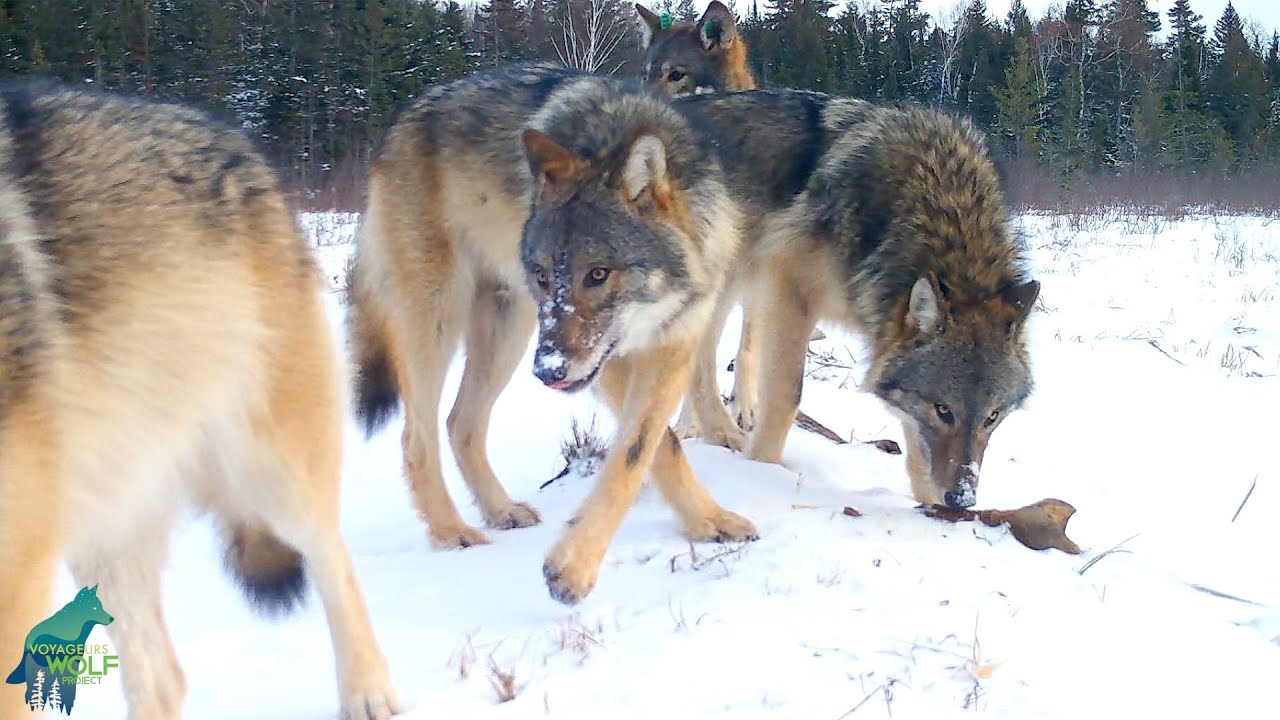
Gray wolf pack stops to sniff the snow

A gray wolf with a dark grizzled back sniffs a brown scrap of bone or hide on the snow, a second wolf in the left foreground and a third wolf with a green ear tag peering from behind.

Footage: Voyageurs Wolf Project · 1:18 · uploaded July 11, 2022
Written by My Crittercam · published November 6, 2026

The Story

Noses down, one after another, a pack of gray wolves works over a patch of snow in front of a trail camera in northern Minnesota. This is the Cranberry Bay Pack, in the remote forest of Voyageurs, in early December 2021.

They come in thick-coated and grizzled, buff and tan through the legs, gray and black across the back, a classic gray wolf coat. Under those guard hairs sits a dense undercoat that wolves grow each fall and shed by July. Each animal stops where the last one stopped and puts its nose to the ground. Whatever lies there, nobody wants to be the wolf that skipped it.

Leading them is a weathered gray male the Voyageurs Wolf Project knows as V083, the breeding male of the pack and its famed beaver killer. The project credits him with 42 beavers in 2020. That fits the local menu, since in northern Minnesota summers wolves mostly hunt small prey such as beavers and deer fawns.

Seven wolves made up the pack that early winter, more than the four or five the project counts as average for its area. The reason was simple. All four of the year's pups survived to winter. Packs are family groups, a breeding male and female with their pups, perhaps last year's young and sometimes older wolves. By freeze-up in the Voyageurs area, pups are the size of small adults and can travel with their parents and the rest of the pack.

Daylight footage like this is a small stroke of luck. Wolves are mainly nocturnal, and in fall and winter Minnesota wolves spend most of their time sleeping, resting or traveling, with little time spent feeding.

The pack did not hold at seven. Sometime in mid-to-late winter it dropped to six, through a death or a wolf dispersing, which the project calls common. V083 and his mate kept leading it, and in 2022 they likely produced another litter, though only trail camera footage could confirm it.
Field Guide

The Cranberry Bay Pack, seven strong in early December 2021, stops nose-down in the snow in front of a trail camera in Voyageurs. Full field guide for the Gray wolf

Common nameGray wolf
Scientific nameCanis lupus
FamilyCanidae (Dog family)
SizeMales 5 to 6.5 ft long nose to tail tip, females 4.5 to 6 ft; 26 to 32 in at the shoulderU.S. Fish & Wildlife Service (hosted by Montana Fish, Wildlife & Parks)
WeightMales 70 to 115 lb, females 60 to 100 lb; Alaska males occasionally 145 lbU.S. Fish & Wildlife Service (hosted by Montana Fish, Wildlife & Parks)
DietMainly medium and large hoofed mammals. Midwest: mainly white-tailed deer, also moose, beaver and snowshoe hare; Rocky Mountains: elk, deer, moose, bison and beaverU.S. Fish & Wildlife Service (hosted by Montana Fish, Wildlife & Parks) · U.S. Fish & Wildlife Service
RangeLower 48: Minnesota, Wisconsin, Michigan, Montana, Idaho, Wyoming and northern Washington's Cascades; tens of thousands in Canada and AlaskaU.S. Fish & Wildlife Service (hosted by Montana Fish, Wildlife & Parks) · NatureServe Explorer
Active whenMainly nocturnal; movements are usually at night and cover long distancesNatureServe Explorer · Animal Diversity Web, University of Michigan
LifespanUp to 13 years in the wild, 15 in captivity; Yellowstone average 4-5 yearsU.S. Fish & Wildlife Service (hosted by Montana Fish, Wildlife & Parks) · National Park Service, Yellowstone National Park
Conservation statusNatureServe global rank G5. US Endangered Species Act: threatened in Minnesota, endangered in most other lower-48 states; Northern Rocky Mountain population delistedNatureServe Explorer
Cam notes · Cameratrail camera
Cam notes · Time of dayday
Cam notes · Seasonearly winter, early December 2021, snow on the ground
Cam notes · Placeremote forest of Voyageurs, northern Minnesota

Habitat

Behavior

Questions

How big is a gray wolf?

Adult males average 70 to 115 pounds and stand 26 to 32 inches at the shoulder. Yellowstone males average 110 pounds and females 90 pounds.U.S. Fish & Wildlife Service (hosted by Montana Fish, Wildlife & Parks) · National Park Service, Yellowstone National Park

What do these Minnesota wolves eat?

In the Midwest wolves mainly eat white-tailed deer, along with moose, beaver and snowshoe hare. In northern Minnesota summers they mostly hunt small prey such as beavers and deer fawns.U.S. Fish & Wildlife Service (hosted by Montana Fish, Wildlife & Parks) · U.S. Fish & Wildlife Service · Voyageurs Wolf Project, University of Minnesota

Is a wolf pack dangerous to people?

Aggressive behavior by wild wolves toward people is extremely rare; in Alaska and Canada there were 16 cases of non-rabid wolves biting people since 1970. Risk rises when wolves are habituated, for example by being fed.U.S. Fish & Wildlife Service (hosted by Montana Fish, Wildlife & Parks) · Minnesota Department of Natural Resources

Latest clips