My Crittercam
My Crittercam › Gray wolf

Gray wolf fills a 360 lens in Yellowstone snow

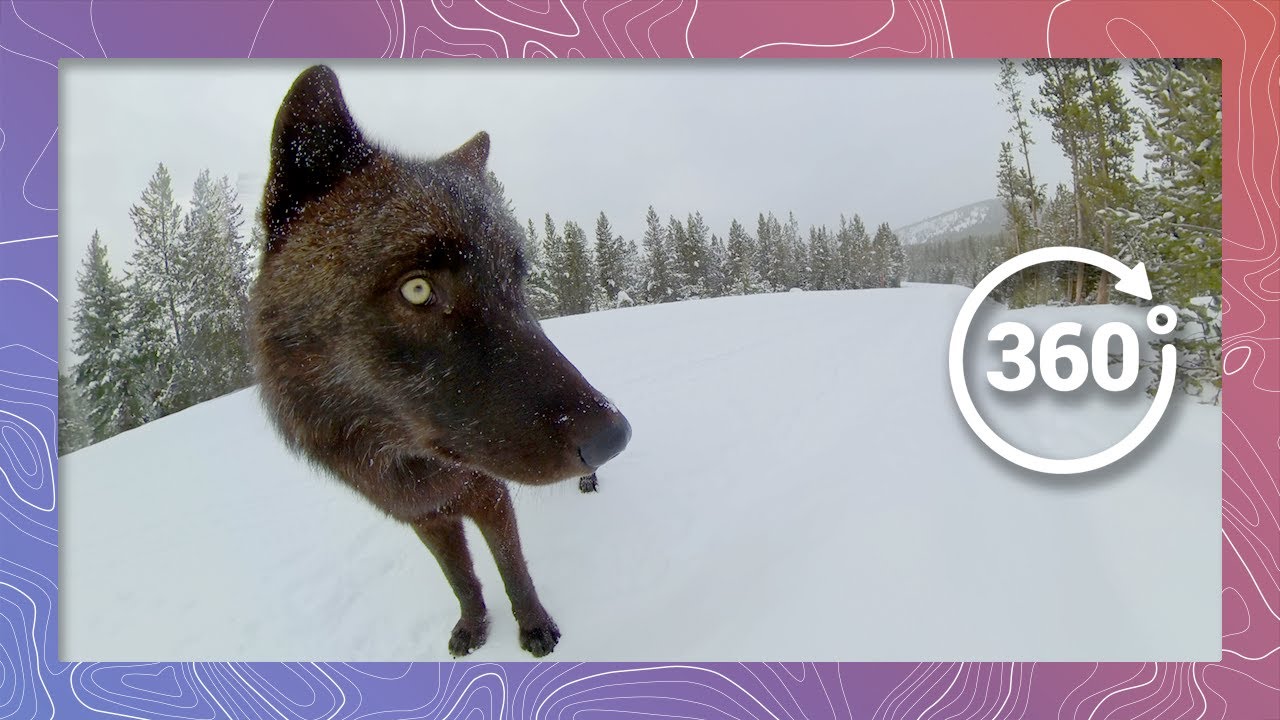
A dark-coated gray wolf with a pale eye and snow flecks in its fur stands in snow close to the lens, head turned aside and enlarged by the wide angle, with snowy conifers behind and patterned purple border bands above and below.

Footage: Wildlife Protection Solutions · 3:50 · uploaded June 15, 2021
Written by My Crittercam · published November 6, 2026

The Story

Nothing can sneak up on a camera that sees in every direction, which is no help at all once a gray wolf walks over and puts its teeth on it. It is a snowy winter in the Greater Yellowstone Ecosystem, and a pack is roaming its territory with a 360 camera sitting out on the snow.

One visitor is all head. A dark wolf stands so close that the wide lens swells its skull and shrinks its legs to stilts, snow flecked across its ears, one pale eye turned on the glass. That lens flatters nobody. In life a gray wolf has relatively short, rounded ears and a large, blocky muzzle, nothing like this tapered snout. The dark coat needs no correction: in Yellowstone, gray and black wolves occur about 50:50.

For a while the camera just gets looked over. Wolves come up close enough to put a nose to it, then move on across the snow. Gray wolves are mainly nocturnal, with movements usually at night, so a wolf out on open snow in daylight is a good piece of luck.

Then the manners run out. Mouths close on the camera, snow flies across the lens, and the gnawing starts in earnest. The camera does not come out of this well.

The why is harder to pin down. Wolves are shy but very curious by nature, and pups play with bones, feathers or animal skins, 'killing' them and carrying them as trophies. Nothing here shows how old these animals are, so that stays a comparison and not an answer.

The pack has bigger business out here anyway. Across the park, Yellowstone packs average a home range of 428 square kilometers, defended by howling and urine scent marks, and elk make up over 96% of winter prey. A camera on the snow is a very small item in all that country.
Field Guide

In snowy Greater Yellowstone, wolves walk right up to a 360 camera, look it over, then set about gnawing it. Full field guide for the Gray wolf

Common nameGray wolf
Scientific nameCanis lupus
FamilyCanidae (Dog family)
SizeMales 5 to 6.5 ft long nose to tail tip, females 4.5 to 6 ft; 26 to 32 in at the shoulderU.S. Fish & Wildlife Service (hosted by Montana Fish, Wildlife & Parks)
WeightMales 70 to 115 lb, females 60 to 100 lb; Alaska males occasionally 145 lbU.S. Fish & Wildlife Service (hosted by Montana Fish, Wildlife & Parks)
DietMainly medium and large hoofed mammals. Midwest: mainly white-tailed deer, also moose, beaver and snowshoe hare; Rocky Mountains: elk, deer, moose, bison and beaverU.S. Fish & Wildlife Service (hosted by Montana Fish, Wildlife & Parks) · U.S. Fish & Wildlife Service
Active whenMainly nocturnal; movements are usually at night and cover long distancesNatureServe Explorer · Animal Diversity Web, University of Michigan
RangeLower 48: Minnesota, Wisconsin, Michigan, Montana, Idaho, Wyoming and northern Washington's Cascades; tens of thousands in Canada and AlaskaU.S. Fish & Wildlife Service (hosted by Montana Fish, Wildlife & Parks) · NatureServe Explorer
LifespanUp to 13 years in the wild, 15 in captivity; Yellowstone average 4-5 yearsU.S. Fish & Wildlife Service (hosted by Montana Fish, Wildlife & Parks) · National Park Service, Yellowstone National Park
Conservation statusNatureServe global rank G5. US Endangered Species Act: threatened in Minnesota, endangered in most other lower-48 states; Northern Rocky Mountain population delistedNatureServe Explorer
Cam notes · Camera360 camera, filmed in 5K 360
Cam notes · Time of dayday (cover frame)
Cam notes · Seasonsnowy winter
Cam notes · PlaceGreater Yellowstone Ecosystem

Habitat

Behavior

Questions

How big is a gray wolf?

Adult males average 70 to 115 pounds and stand 26 to 32 inches at the shoulder. Yellowstone males average 110 pounds and females 90 pounds.U.S. Fish & Wildlife Service (hosted by Montana Fish, Wildlife & Parks) · National Park Service, Yellowstone National Park

Is a black wolf still a gray wolf?

Yes, the gray wolf comes in more than one coat, and it is often buff-tan grizzled with gray and black. In Yellowstone, gray and black wolves occur about 50:50, and white is rare.U.S. Fish & Wildlife Service (hosted by Montana Fish, Wildlife & Parks) · National Park Service, Yellowstone National Park

Is a wolf dangerous to people?

Aggressive behavior by wild wolves toward people is extremely rare, but investigations found wolves killed a young man in Saskatchewan in 2005 and a woman in Alaska in 2010. Risk rises when wolves are habituated, for example by being fed.U.S. Fish & Wildlife Service (hosted by Montana Fish, Wildlife & Parks) · Minnesota Department of Natural Resources

Latest clips