The Story
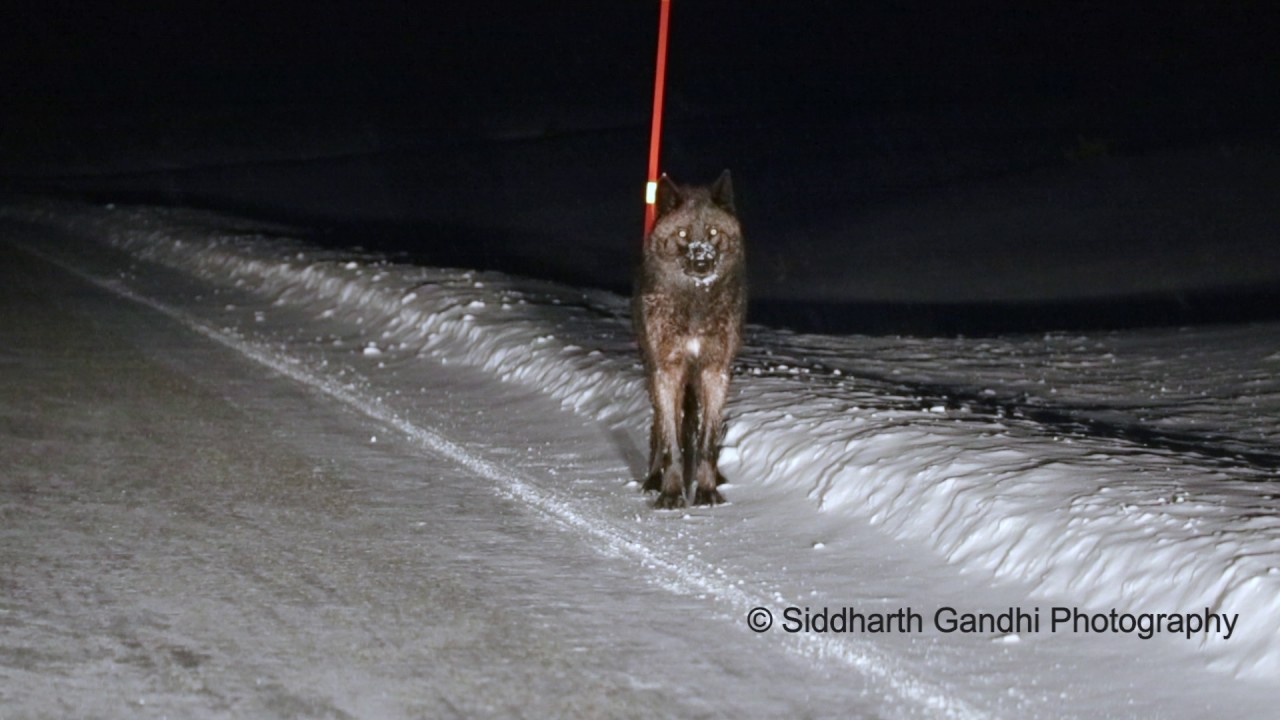
Light catches a gray wolf standing on a snow-packed road in Yellowstone at night. It faces square into the beam and looks straight back.
That is all the footage gives: one wolf, a winter night, snow and a road. What it does give is the stare, held straight down the beam at whoever is behind it.
Up close, the size is what lands. Gray wolves are roughly twice the size of a coyote. Males run 70 to 115 pounds and stand 26 to 32 inches at the shoulder, and in Yellowstone the average male weighs about 110 pounds, the average female about 90. A wolf also gives itself away by its head: short, rounded ears and a large, blocky muzzle where a coyote's is pointed and petite.
The hour fits the animal. Wolves are mainly nocturnal, and their movements are usually at night and cover long distances. They trot at about 5 miles an hour and may travel as far as 30 miles a day hunting. In a Yellowstone winter that hunting means elk, which make up more than 96 percent of the wolves' winter prey.
Winter is built into the body, too. A dense undercoat grows in under the outer guard hairs each fall, and big feet work like snowshoes, with hair between the toes that keeps snow from freezing there.
This one is alone in the frame. Wolves live in packs that are family groups, and a Yellowstone pack averages close to ten animals, but whether any of them are out past the reach of the light, the footage does not say. Wolves are shy but very curious, and aggressive behavior by wild wolves toward people is extremely rare. The risk climbs when wolves get used to people, for example by being fed. Here there is only the wolf, the snow and the dark road behind it.