The Story
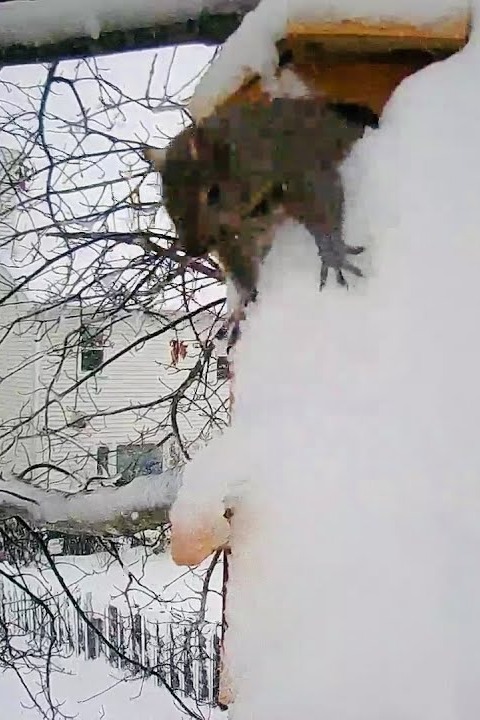
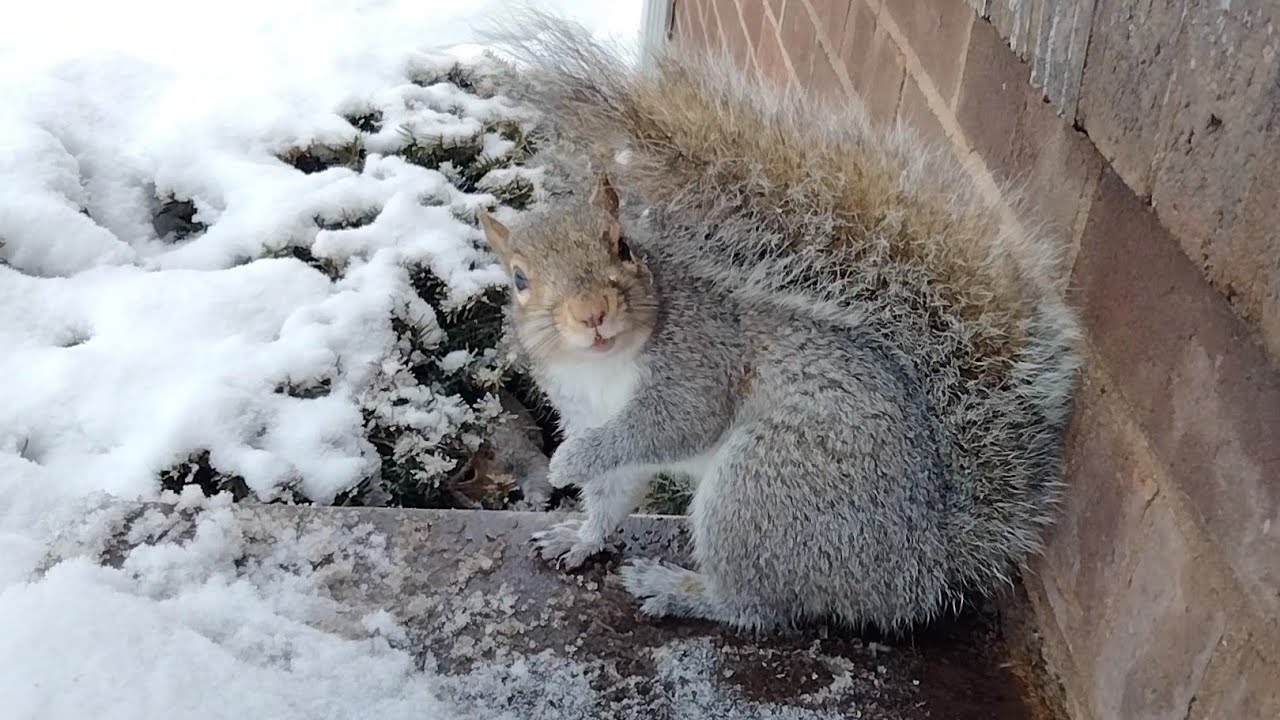
Snow sits heavy on the shrubs, and a frost-dusted ledge against a brick wall holds one eastern gray squirrel, white chest square to the lens, tail hoisted up over its back like a raised hood.
Squirrels are regulars at this window, and this one's field marks are textbook. A grizzled gray coat, a white belly and chest, a tail almost half as long as the body. That white underside is the quick way to rule out the larger eastern fox squirrel, whose belly and tail fringe run reddish yellow.
Winter is the test, and the tail is the first answer. Gray squirrels do not hibernate. They stay active all year and can feed through rain or snow, keeping dry and warm under the tail arched over the back, the very pose this one holds on the ledge. Mass Audubon says that in winter they come out only at midday, and ADW puts the single winter peak two to four hours before sunset.
Food is the second answer. The filmer sets out mixed nuts in white bowls, and several squirrels come through the snow for them. One decides the bowl itself is worth keeping and tries to haul off the whole thing, which shows ambition if not table manners.
Under the comedy sits the species' real strategy. Gray squirrels scatter-hoard, burying nuts in many separate caches rather than one store, and find them again by memory and smell. In Ohio, their winter survival and spring breeding are closely tied to the previous fall's mast crop.
Shelter is the third. Tree cavities are preferred homes, especially in winter, and large ones are often filled with leaves in fall and spring for insulation; winter leaf nests of bare twigs and interlaced leaves are usually very substantial. Gray squirrels are more social than fox or red squirrels, and several may share one shelter nest. Studies cited by ADW found black-morph squirrels have 18 percent lower heat loss below minus 10 degrees Celsius. This one is standard gray, and its tail is up.