Eastern gray squirrel field guide
Field Guide
| Common name | Eastern gray squirrel |
|---|---|
| Scientific name | Sciurus carolinensis |
| Family | Sciuridae (squirrels) |
| Size | Total length 380 to 525 mm, tail 150 to 250 mm; Missouri: 14 to 21 inches totalAnimal Diversity Web, University of Michigan Museum of Zoology · Missouri Department of Conservation |
| Weight | 338 to 750 g, average 540.33 g; Missouri: 3/4 to 1 1/2 poundsAnimal Diversity Web, University of Michigan Museum of Zoology · Missouri Department of Conservation |
| Lifespan | Up to 12.5 years in the wild; a captive female lived more than 20 yearsAnimal Diversity Web, University of Michigan Museum of Zoology |
| Diet | Omnivore: mostly nuts (acorns, hickory, walnut, beech), seeds, buds, flowers, fruit and fungi; also corn, insects, bird eggs, nestlings and frogsAnimal Diversity Web, University of Michigan Museum of Zoology · Mass Audubon |
| Active when | Daytime, year-round; spring to fall peaks about 2 hours after sunrise and 2-5 hours before sunset; winter single peak 2-4 hours before sunsetAnimal Diversity Web, University of Michigan Museum of Zoology · Mass Audubon |
| Range | Eastern United States to just west of the Mississippi River and north to Canada; introduced in western states and parts of CanadaAnimal Diversity Web, University of Michigan Museum of Zoology |
| Conservation status | IUCN Red List: Least Concern; NatureServe global rank G5 (Secure)NatureServe Explorer · Animal Diversity Web, University of Michigan Museum of Zoology |
Field Marks
- Grizzled dark to pale gray back, sometimes with cinnamon tones; underparts gray to buff; ears pale gray to whiteAnimal Diversity Web, University of Michigan Museum of Zoology
- Tail fringe and belly white, separating it from the larger eastern fox squirrel, whose tail fringe and belly are reddish yellowMissouri Department of Conservation
- Many have white trim on the back of the ears and a straw-colored ring around the eyesOhio Department of Natural Resources
- Large fluffy tail almost half its body lengthMass Audubon
- Black (melanistic) and white individuals are gray squirrels with more or less pigment, not separate species; true albinos have pink eyesMass Audubon
Habitat
- Prefers mature continuous woodland larger than 40 hectares with diverse understory; densities are highest where oaks and walnuts supply storable winter foodAnimal Diversity Web, University of Michigan Museum of Zoology
- Comfortable in suburbs and cities; in Massachusetts look for it wherever nut-bearing trees such as oak, hickory or beech growMass Audubon
- In Missouri more common in bottomlands and along rivers with a bushy understory; also lives in urban areas, especially where large oak and hickory trees are commonMissouri Department of Conservation
- Uses two kinds of home: a permanent tree den and a nest of leaves and twigs (drey) on a tree crotch 30-45 feet above the groundAnimal Diversity Web, University of Michigan Museum of Zoology
- Dreys can be a foot or two wide, usually 20 feet or higher, built near the trunk or in a strong fork of a food tree such as an oakMass Audubon
- Each squirrel uses a home range of no more than 5 acres in the Chesapeake Bay watershedChesapeake Bay Program
Behavior
- Scatter-hoards: buries food in many separate caches across the landscape rather than one storeAnimal Diversity Web, University of Michigan Museum of Zoology · Scientific American
- Finds caches by both memory and smellAnimal Diversity Web, University of Michigan Museum of Zoology
- In a 1991 enclosure study of eight hand-raised gray squirrels given 10 nuts each, they retrieved twice as many of their own nuts as another squirrel's and planned routes through their cachesScientific American
- In a 1997 experiment, gray squirrels could remember up to 24 cache locations for up to two monthsScientific American
- Many unrecovered buried nuts eventually germinate, so squirrels essentially plant nut trees; ADW says seed caching may help disperse tree seedsMissouri Department of Conservation · Animal Diversity Web, University of Michigan Museum of Zoology
- Bird feeders provide a bonanza of food; squirrels can jump six feet straight up and launch 10 feet or more from a tree, building or railing to reach oneMass Audubon
- Takes birds' eggs and nestlings from open nests and gnaws into birdhouses in summerMass Audubon
- Communicates with vocalizations and postures such as tail flicking, and reads stress and breeding condition of neighbors by smellAnimal Diversity Web, University of Michigan Museum of Zoology
- Becomes noisy when alarmed or angry, chattering, rasping and barking; gives warning calls when predators are nearChesapeake Bay Program
- Breeds twice a year, December-February and May-June, slightly later farther north; courtship features noisy chases through the treetopsAnimal Diversity Web, University of Michigan Museum of Zoology · Mass Audubon
- Gestation is 44 days; litters, born in late winter and midsummer, are generally 2-4 young (up to 8)Animal Diversity Web, University of Michigan Museum of Zoology
- Young are born without teeth or fur, eyes and ears shut; eyes open at about 36 days and they venture out of the nest onto the ground at about 10 weeksOhio Department of Natural Resources
- More social than fox and red squirrels; several gray squirrels may share a shelter nestOhio Department of Natural Resources
- Gnaws constantly on bark, wood, plastic or metal because its incisors grow throughout lifeMass Audubon
- Often eats sitting on rocks or logs, leaving piles of walnut, hickory and acorn shellsMissouri Department of Conservation
Winter
- Stays active year-round and can feed in rain or snowstorms, keeping dry and warm under its broad tail arched and spread over its backMass Audubon
- Mass Audubon: in winter gray squirrels only come out at midday. ADW: winter activity has a single peak 2-4 hours before sunsetMass Audubon · Animal Diversity Web, University of Michigan Museum of Zoology
- Tree cavities are preferred homes, especially in winter; large cavities are commonly filled with leaves in fall and spring for insulation. Winter-built leaf nests use bare twigs with interlaced leaves and are usually very substantialMissouri Department of Conservation
- Studies cited by ADW found black-morph squirrels have 18% lower heat loss below -10 degrees Celsius, a 20% lower basal metabolic rate and 11% higher nonshivering thermogenesis capacity than gray morphsAnimal Diversity Web, University of Michigan Museum of Zoology
- In Ohio, gray squirrel winter survival and spring reproduction are closely tied to the previous fall's mast crop; in Missouri, squirrel numbers fluctuate after good or bad mast yearsOhio Department of Natural Resources · Missouri Department of Conservation
Questions
How big is an eastern gray squirrel?
Total length is 380 to 525 mm (about 15 to 21 inches), with a tail of 150 to 250 mm. Adults weigh 338 to 750 g, about 3/4 to 1 1/2 pounds.Animal Diversity Web, University of Michigan Museum of Zoology · Missouri Department of Conservation
Why do squirrels bury acorns?
Gray squirrels scatter-hoard, burying nuts in many separate caches to eat in winter. They find them again using memory and smell.Animal Diversity Web, University of Michigan Museum of Zoology · Scientific American
Do squirrels remember where they buried their nuts?
Yes, in experiments. In a 1991 enclosure study eight hand-raised gray squirrels retrieved twice as many of their own nuts as another squirrel's, and in a 1997 experiment they remembered up to 24 caches for up to two months.Scientific American
Is a black squirrel a different species?
No. Black squirrels are melanistic gray squirrels with more pigment than normal; Mass Audubon says their incidence seems to be greater in the North, and ADW also reports more black-coated squirrels in the north.Mass Audubon · Animal Diversity Web, University of Michigan Museum of Zoology
Where do squirrels sleep in winter?
In tree cavities lined with leaves, or in leaf-and-twig nests called dreys. Winter dreys are built of bare twigs with interlaced leaves and are sturdier than summer nests.Missouri Department of Conservation · Mass Audubon
Do gray squirrels hibernate?
No. Mass Audubon says squirrels remain active year-round and can feed during rain or snowstorms, keeping dry and warm under their tail.Mass Audubon
Why is a squirrel always at my bird feeder?
Squirrels love seeds, and bird feeders provide a bonanza of nourishment. They can jump six feet straight up and launch 10 feet or more from a tree, building or railing to reach a feeder.Mass Audubon
What eats squirrels?
Predators include mink, weasels, red foxes, bobcats, coyotes, owls, hawks, domestic cats and dogs. Squirrels give warning calls when a predator is near.Animal Diversity Web, University of Michigan Museum of Zoology · Missouri Department of Conservation · Chesapeake Bay Program
Why does a squirrel flick its tail?
Tail flicking is one of the postures gray squirrels use to communicate. The tail is also used for balance and warmth.Animal Diversity Web, University of Michigan Museum of Zoology · Chesapeake Bay Program
Clips
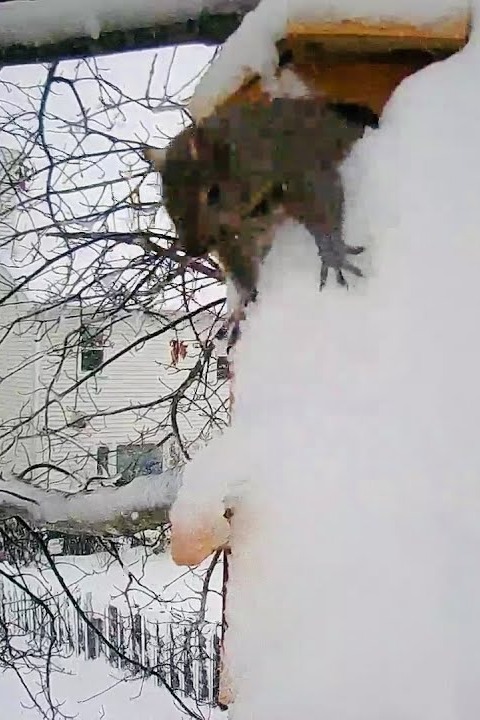 Gray squirrel clings to a snow-caked nest box
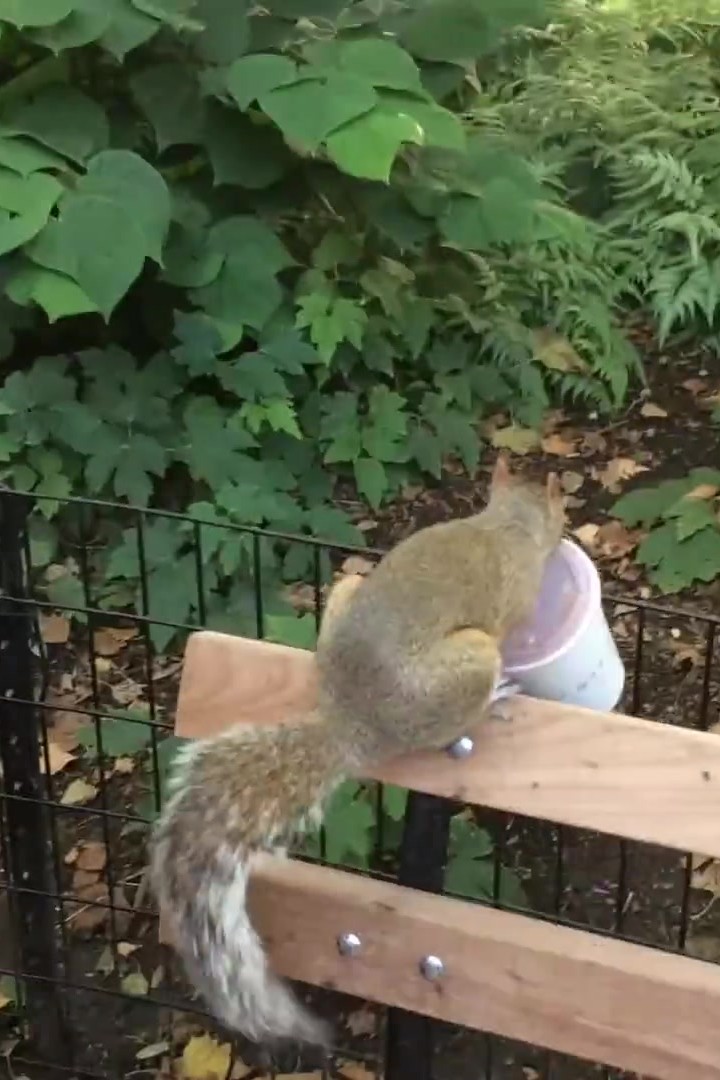 Trash can milkshake for a New York gray squirrel
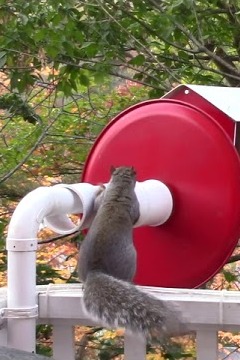 Pizza plate feeder stumps a gray squirrel
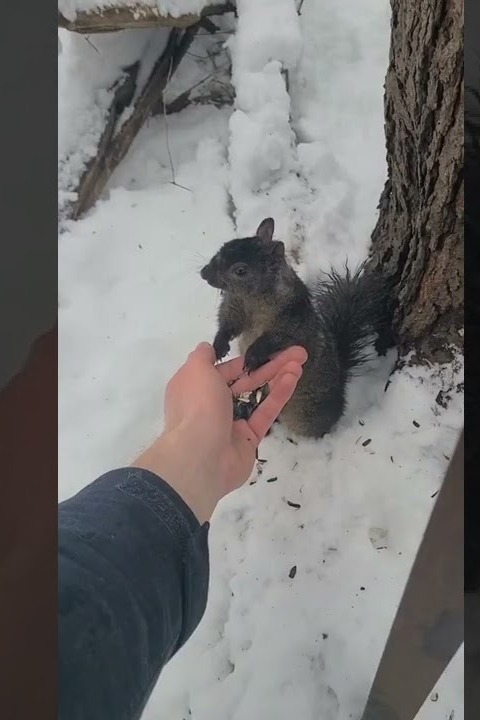 Black squirrel takes seeds from a hand in snow
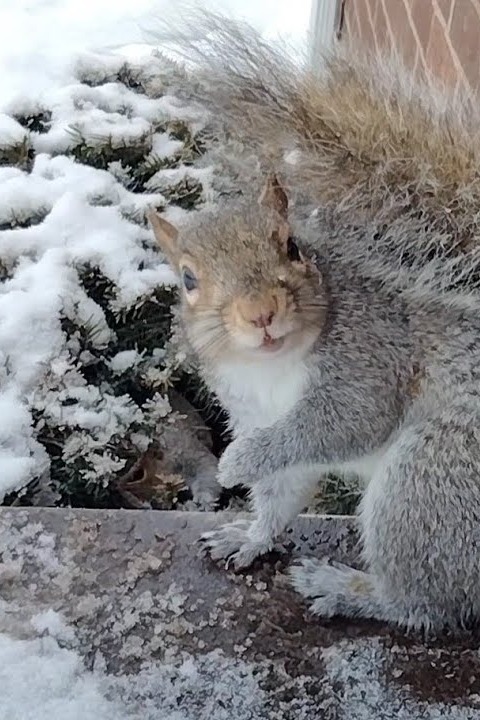 Gray squirrel tail-up on a snowy window ledge
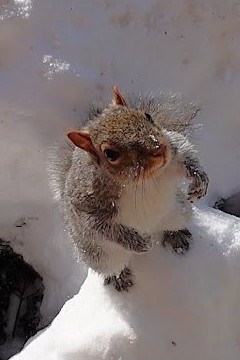 Gray squirrel stands tall in a tunneled snowbank
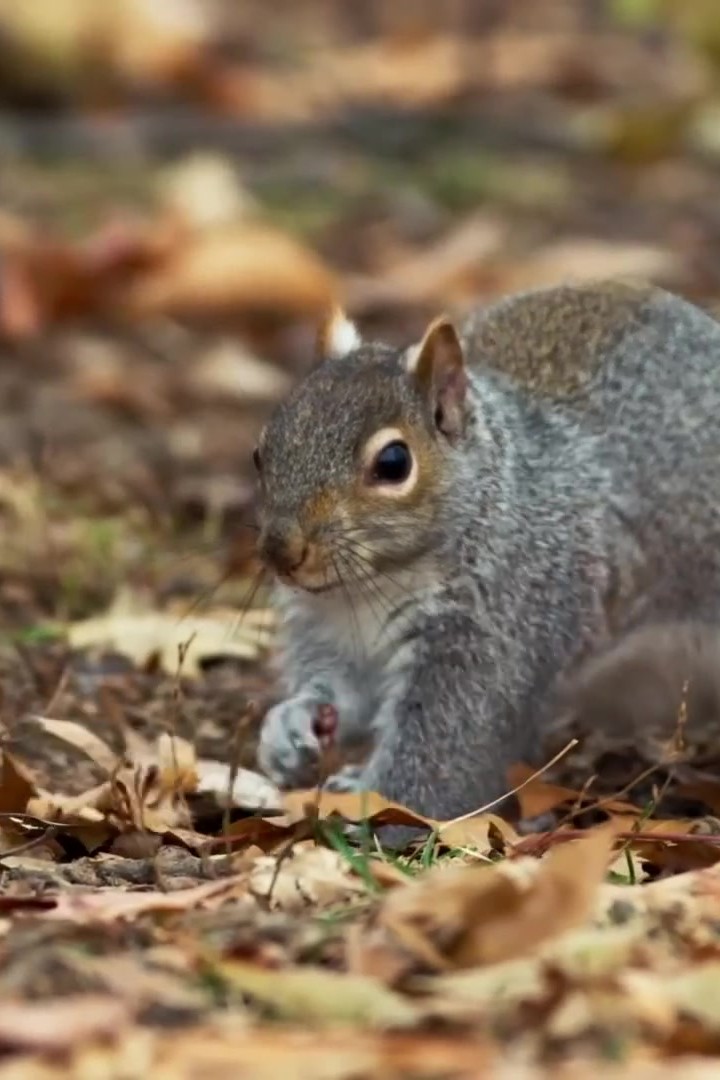 Gray squirrel fakes a burial to fool a thief
Two eastern gray squirrels share one snow-caked nest box through a severe Midwest storm, curling up and tussling until one is ready to head out.
An eastern gray squirrel in a New York trash can pulls the straw from a Shake Shack cup and drinks the chocolate shake while the people filming cheer from above.
A gray squirrel on a deck rail weighs a jump to a chickadee feeder guarded by a red pizza plate and spinning PVC joints, while others land on it and slide off.
Little Bean, a black squirrel who lost fur to a skin condition one winter, stands in the snow with her paws on a hand of seeds, her coat grown back.
A gray squirrel sits tail-up on a frosted ledge outside a window in deep snow, and another squirrel at the same window tries to make off with the whole nut bowl.
Squirrels dig tunnels through a deep backyard snowbank to reach a feeding window, and one stands up in the sun with snow on its nose.
A gray squirrel that lost one buried acorn to a thief stages a fake burial for her and keeps the real nut in his mouth.
Sources
- Sciurus carolinensis (eastern gray squirrel), Animal Diversity Web, University of Michigan Museum of Zoology
- Squirrels (Eastern gray squirrel), Mass Audubon
- Eastern Gray Squirrel and Eastern Fox Squirrel, Missouri Department of Conservation
- Eastern Gray Squirrel, Ohio Department of Natural Resources
- Eastern gray squirrel (Field Guide), Chesapeake Bay Program
- Sciurus carolinensis, NatureServe Explorer
- Do Squirrels Remember Where They Buried Their Nuts? (Emma Bryce, 2023-11-20; reports Jacobs & Liman 1991, Animal Behaviour 41:103-110), Scientific American