My Crittercam
My Crittercam › Gray wolf

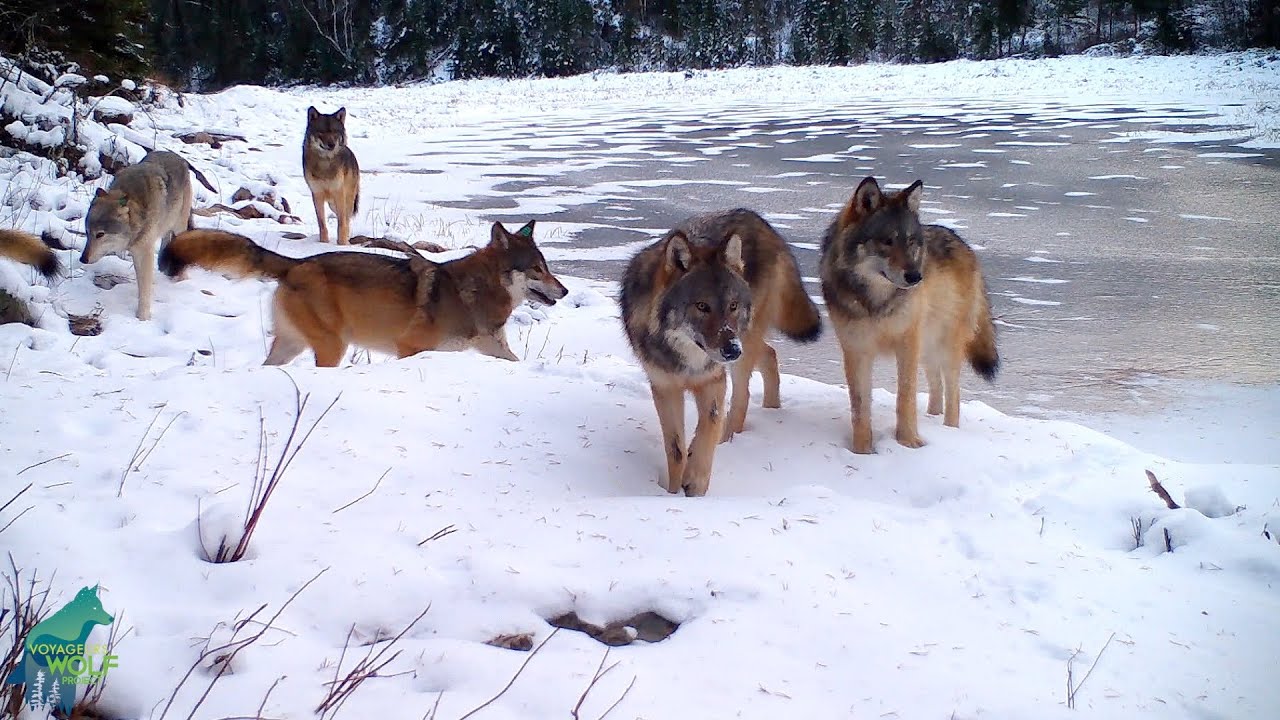
Cranberry Bay gray wolves on a freezing shore

Three gray wolves on a snowy shore beside water skimmed with new ice, the center wolf facing the camera, a reddish wolf with a green ear tag at the left edge, snowy conifers behind.

Footage: Voyageurs Wolf Project · 0:43 · uploaded January 18, 2022
Written by My Crittercam · published November 6, 2026

The Story

The ice is barely made when the Cranberry Bay Pack, a family of gray wolves in northern Minnesota's Voyageurs National Park, travels along the shore past a trail camera, every member in a single frame.

That rarely happens, and the researchers who run the camera know some of these wolves by number. Two wolves carry ear tags. The lighter gray one is V083, the breeding male; the darker one is V084, the breeding female. Both wore collars from 2019 until that fall, when the collars dropped off.

The winter before, the pack was four wolves. Four pups followed in spring, and at least three made it to fall, perhaps all four. Three of the wolves in the clip are plainly pups. A fourth is harder to call. In the Voyageurs area, pups are the size of small adults by freeze-up and can travel with their parents and other pack members.

A pack is a family, built around a breeding male and female, their pups, perhaps last year's young and sometimes older wolves. Midwest packs average four to eight wolves in winter. If last winter's four are all still in it, three or four surviving pups would put this one near the top of that range.

Coats in the pack run from lighter gray to darker, rusty tones, and the species is often buff-tan grizzled with gray and black. Each fall a wolf grows a dense undercoat beneath its outer guard hairs. Big feet work like snowshoes, with hair between the toes to stop snow freezing there.

Freeze-up redraws the map. Around Voyageurs, frozen shorelines become wolf pathways, and wind-swept frozen beaver ponds often hold less snow than the forest. Early on, one wolf slips on the ice. In fall and winter, Minnesota wolves spend most of their time sleeping, resting or traveling, and little of it feeding. One by one they pass close to the camera, a black-tipped tail swinging out of the shot, while a straggler still stands at the edge of the new ice.
Field Guide

At freeze-up in a remote part of Voyageurs National Park, the entire Cranberry Bay Pack, tagged breeding pair and this year's pups, passes one trail camera together. Full field guide for the Gray wolf

Common nameGray wolf
Scientific nameCanis lupus
FamilyCanidae (Dog family)
SizeMales 5 to 6.5 ft long nose to tail tip, females 4.5 to 6 ft; 26 to 32 in at the shoulderU.S. Fish & Wildlife Service (hosted by Montana Fish, Wildlife & Parks)
WeightMales 70 to 115 lb, females 60 to 100 lb; Alaska males occasionally 145 lbU.S. Fish & Wildlife Service (hosted by Montana Fish, Wildlife & Parks)
DietMainly medium and large hoofed mammals. Midwest: mainly white-tailed deer, also moose, beaver and snowshoe hare; Rocky Mountains: elk, deer, moose, bison and beaverU.S. Fish & Wildlife Service (hosted by Montana Fish, Wildlife & Parks) · U.S. Fish & Wildlife Service
Active whenMainly nocturnal; movements are usually at night and cover long distancesNatureServe Explorer · Animal Diversity Web, University of Michigan
RangeLower 48: Minnesota, Wisconsin, Michigan, Montana, Idaho, Wyoming and northern Washington's Cascades; tens of thousands in Canada and AlaskaU.S. Fish & Wildlife Service (hosted by Montana Fish, Wildlife & Parks) · NatureServe Explorer
LifespanUp to 13 years in the wild, 15 in captivity; Yellowstone average 4-5 yearsU.S. Fish & Wildlife Service (hosted by Montana Fish, Wildlife & Parks) · National Park Service, Yellowstone National Park
Conservation statusNatureServe global rank G5. US Endangered Species Act: threatened in Minnesota, endangered in most other lower-48 states; Northern Rocky Mountain population delistedNatureServe Explorer
Cam notes · Cameratrail camera
Cam notes · Time of dayday
Cam notes · Seasonfall, at freeze-up
Cam notes · Placea remote part of Voyageurs National Park, northern Minnesota

Habitat

Behavior

Questions

How many wolves are in a pack?

Midwest packs average four to eight wolves in winter, with records of up to 16. In Yellowstone the average pack is 9.8 wolves, and the largest recorded, Druid Peak, reached 37 in 2001.U.S. Fish & Wildlife Service (hosted by Montana Fish, Wildlife & Parks) · National Park Service, Yellowstone National Park

How do wolves handle a Minnesota winter?

A dense undercoat grows in under the guard hairs each fall. Big feet work like snowshoes, and hair between the toes keeps snow from freezing there.International Wolf Center · International Wolf Center · Animal Diversity Web, University of Michigan

What do wolves in northern Minnesota eat?

In the Midwest, wolves eat mainly white-tailed deer, plus moose, beaver and snowshoe hare. In northern Minnesota summers they mostly hunt small prey such as beavers and deer fawns.U.S. Fish & Wildlife Service (hosted by Montana Fish, Wildlife & Parks) · Voyageurs Wolf Project, University of Minnesota

Latest clips