The Story
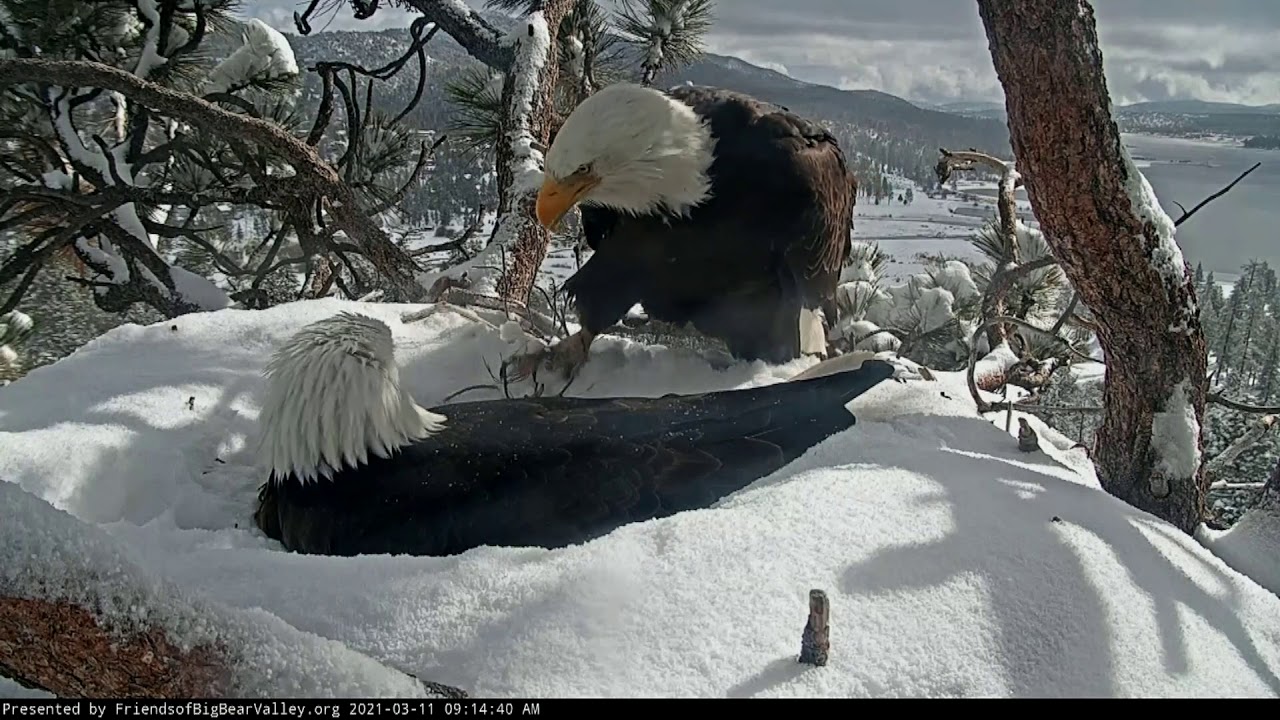
Snow lies deep on a nest about 145 feet up a pine at Big Bear Lake, California, and a bald eagle sits sunk in it to the shoulders. A second adult drops onto the rim and puts a stick on the sitter's tail feathers.
It is a Thursday morning, and under the sitting bird are two eggs. Moments later the sitter lifts off and leaves, and the newcomer settles onto the eggs in its place. What the stick means, if it means anything, is the eagles' own business.
Both birds wear the white head of adults. In full plumage a bald eagle is snowy white on the head, neck and tail over a dark brown body, and it is the only eagle carrying both a white head and a white tail. That look takes about five years to come in, and pairs first breed at around four or five.
Telling this pair apart takes more than a glance. Female bald eagles are generally larger than males, but with one bird buried in snow and the other hunched over it, the comparison is not a fair one.
Both parents incubate, trading shifts like this one, and the work runs 34 to 36 days. Two eggs is the usual clutch, and these two were expected to hatch in mid-March. The eggs have plenty of takers: ravens, crows, magpies, gulls, black bears, raccoons and bobcats all take eagle eggs or young, while the adults are rarely preyed on.
The nest is a long project. Both parents build it and add to it every year, and most run 4 to 5 feet wide, while one reused for years can reach 10 feet across and thousands of pounds. Bald eagles pick tall trees near water, and pine is among the trees they use. For this pair, today, the job is simpler. Sit down, stay down, and outlast the snow.