My Crittercam
My Crittercam › White-tailed deer

White-tailed deer at a birder's fingertips

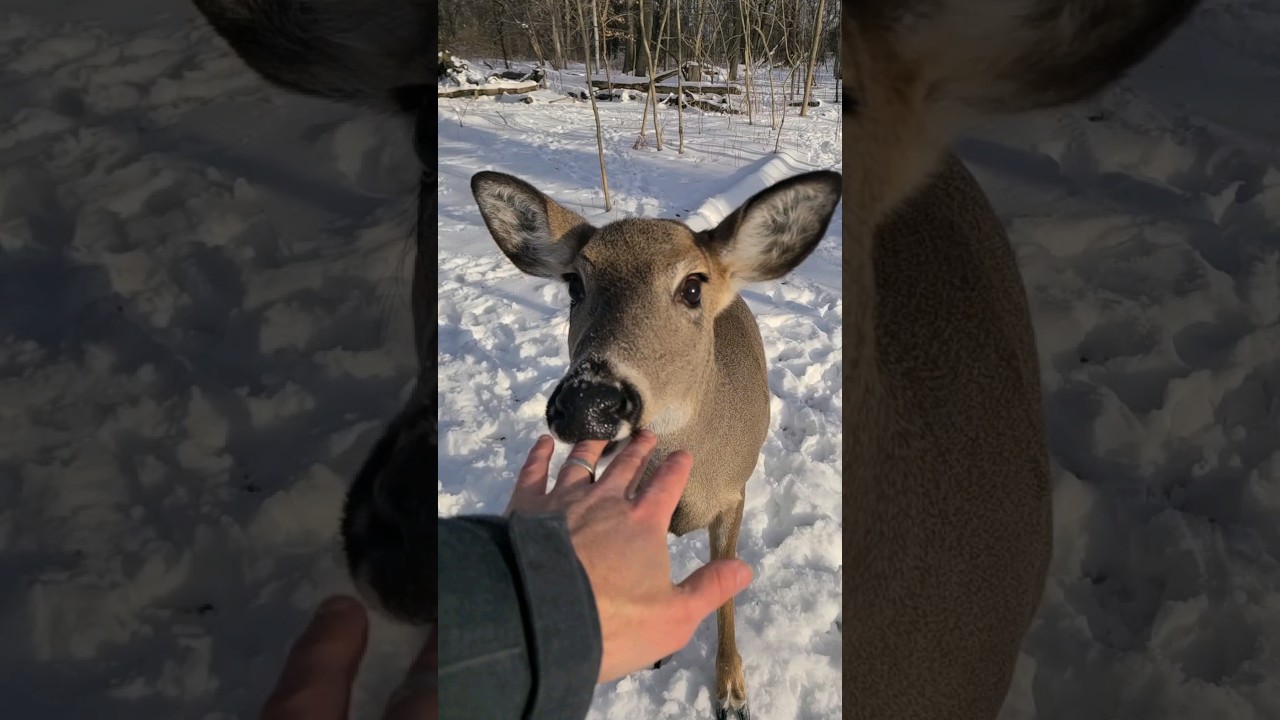
A white-tailed deer with wide pale-lined ears and snow on its black nose stands in a snowy wood of bare trees while a person's ringed hand reaches up to touch its chin.

Footage: Brendan J. Fox · 0:30 · uploaded February 27, 2023
Written by My Crittercam · published November 6, 2026

The Story

A white-tailed deer stands in the snow at arm's length, big ears spread, eyes on the lens. Then it leans in and closes its mouth around a man's finger.

Nobody planned this. The filmer had gone into his local forest to look for birds, and chickadees were landing on his hand when the deer wandered into the shot, rear end first. Curious, it came in close, then took a finger into its mouth for a taste test. He let it.

Up close, the field marks are easy to read. There is the white band behind the black nose, the pale ring around each eye, the white lining of the ears and the white patch on the chin and throat. The coat is the grayish-brown of winter, long and thick, not the reddish tan of summer. There are no antlers, which in winter proves little: bucks shed theirs from mid-December to late January in Connecticut, and mostly in February and March in Missouri.

What makes the moment odd is the direction of travel. A whitetail that suspects a predator blows, forcing air hard through its nostrils to warn every deer nearby. It raises its tail as a white flag and can bound off through tangled forest at up to 30 miles per hour. This one walks toward the man instead.

The finger is not food. White-tailed deer are herbivores, and in winter they live on bark, buds and twigs. They eat fast, store the meal in the rumen, then bring it back up and chew it again before it moves on through further stomachs.

This deer is dressed for the season. In September whitetails molt into dense woolly underfur beneath long hollow guard hairs, and through autumn they lay down fat that by late fall can make up 10 to 25 percent of body weight.
Field Guide

A white-tailed deer in winter coat walks up to a birder with chickadees landing on his hand in a snowy forest and takes his finger in its mouth. Full field guide for the White-tailed deer

Common nameWhite-tailed deer
Scientific nameOdocoileus virginianus
FamilyCervidae (Deer)
DietHerbivore: leaves, twigs, fruits and nuts of trees and shrubs, herbaceous plants, grasses, crops, and occasionally fungi, mosses and lichens.Missouri Department of Conservation
Active whenCrepuscular: typically most active around dawn and dusk; activity may increase throughout the day during the breeding season.Maine Department of Inland Fisheries and Wildlife
RangeMost of southern Canada and the United States (except most of California, Nevada and Utah), south through Central America to Bolivia.Animal Diversity Web, University of Michigan · Connecticut Department of Energy & Environmental Protection
SizeHead and body 150 to 200 cm, tail 10 to 28 cm; 80 to 100 cm at the shoulder.Animal Diversity Web, University of Michigan
Weight57 to 137 kg (125.55 to 301.76 lb). Missouri: females 110-145 lb, males 155-195 lb.Animal Diversity Web, University of Michigan · Missouri Department of Conservation
LifespanMost live about 2 to 3 years; maximum in the wild 20 years, but few live past 10.Animal Diversity Web, University of Michigan
Conservation statusIUCN Red List: Least Concern (via NatureServe Explorer); NatureServe global rank G5.NatureServe Explorer
Cam notes · Camerahandheld, filmed by the person the deer approaches
Cam notes · Time of dayday
Cam notes · Seasonwinter, snow on the ground
Cam notes · Placethe filmer's local forest

Habitat

Behavior

Questions

Is it safe to let a wild deer lick your hand?

At Fire Island National Seashore, the National Park Service advises keeping a safe distance from deer to protect yourself from harm, and never feeding them, because food-conditioning can lead to potentially unsafe encounters.National Park Service

What do deer actually eat in winter?

In winter white-tailed deer eat bark, buds and twigs. In spring and summer they switch to green plants, and in fall to acorns, corn and other nuts.Oklahoma Department of Wildlife Conservation

Is this deer a doe or a buck?

Adult bucks carry spreading, branching antlers, but shed them in winter, from mid-December to late January in Connecticut and mostly in February and March in Missouri. A deer without antlers in the snow can be a doe or a buck that has already dropped them.Connecticut Department of Energy & Environmental Protection · National Park Service, Chattahoochee River National Recreation Area · Missouri Department of Conservation

Latest clips