My Crittercam
My Crittercam › White-tailed deer

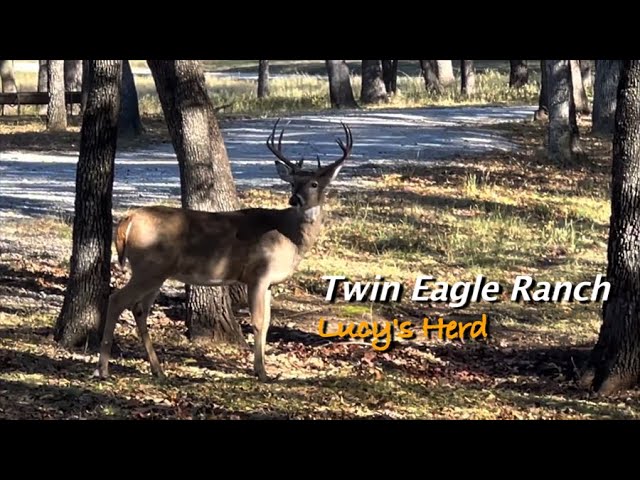
White-tailed buck faces the camera in the rut

A white-tailed buck with branched antlers stands side-on beside a tree trunk in patchy sun with his head turned to the camera, a gravel lane behind him and white and orange ranch-name text burned in, cut off at the lower right.

Footage: Jimmy and Chris Houston's Twin Eagle Ranch · 17:38 · uploaded November 17, 2022
Written by My Crittercam · published November 6, 2026

The Story

A wild white-tailed buck in full rut walks up to a ranch feeder on a cold mid-November morning and starts clearing the table. His neck is thick, his manner is not polite, and he works within six or seven yards of the camera.

It is a Sunday on a ranch in Oklahoma. Fog lifts off the lake as the sun comes up over the hardwoods, and bucks drift in from the back. One young deer carries thirteen points on what the rancher calls his first set of antlers. Then two bigger bucks arrive, and the wild one takes charge, prancing and running everyone else off the food.

The date explains the swagger. Mating peaks in mid-November in Missouri and in the last two weeks of November in Connecticut, and deer activity may increase through the day while it lasts. Rival bucks settle access to a doe by clashing antlers. They do not keep harems.

More than a mile from the house, in the Oak Field, the same contest runs at a slower tempo. A doe stands off to the left, and a buck lies bedded within sight of her, waiting, by the rancher's read, for her to come around. Patience has its logic. A doe in estrus is receptive for about 24 hours, and if she is not bred she comes back into heat every 28 days until early winter.

The turkeys keep their own calendar. Around thirty gather at daylight, and the gobblers strut as though it were spring, whether or not the hens care. When the feeder goes off, the turkeys bolt.

Another morning brings a south wind, a high of 42 sliding back into the 30s, and rain expected to turn to sleet and then snow. Prince Charming, a deer the family came close to losing, is up and walking, stiff-legged but eating. In September deer molt into dense woolly underfur beneath long hollow guard hairs, and by late fall the fat they store can make up 10 to 25 percent of body weight.
Field Guide

On an Oklahoma ranch in mid-November, a wild white-tailed buck in full rut runs the other deer off a feeder six or seven yards from the camera. Full field guide for the White-tailed deer

Common nameWhite-tailed deer
Scientific nameOdocoileus virginianus
FamilyCervidae (Deer)
SizeHead and body 150 to 200 cm, tail 10 to 28 cm; 80 to 100 cm at the shoulder.Animal Diversity Web, University of Michigan
Weight57 to 137 kg (125.55 to 301.76 lb). Missouri: females 110-145 lb, males 155-195 lb.Animal Diversity Web, University of Michigan · Missouri Department of Conservation
DietHerbivore: leaves, twigs, fruits and nuts of trees and shrubs, herbaceous plants, grasses, crops, and occasionally fungi, mosses and lichens.Missouri Department of Conservation
Active whenCrepuscular: typically most active around dawn and dusk; activity may increase throughout the day during the breeding season.Maine Department of Inland Fisheries and Wildlife
RangeMost of southern Canada and the United States (except most of California, Nevada and Utah), south through Central America to Bolivia.Animal Diversity Web, University of Michigan · Connecticut Department of Energy & Environmental Protection
LifespanMost live about 2 to 3 years; maximum in the wild 20 years, but few live past 10.Animal Diversity Web, University of Michigan
Conservation statusIUCN Red List: Least Concern (via NatureServe Explorer); NatureServe global rank G5.NatureServe Explorer
Cam notes · Camerahandheld, narrated on foot and from a truck
Cam notes · Time of daymorning, around sunrise
Cam notes · Seasonmid-November; title dated November 16
Cam notes · Placea ranch in Oklahoma

Habitat

Behavior

Questions

Is it safe to be this close to a wild buck?

At Fire Island National Seashore the National Park Service advises keeping a safe distance from deer to protect yourself from harm and never feeding them, because food-conditioning can lead to potentially unsafe encounters. In the breeding season, rival bucks fight by clashing their antlers.National Park Service · Animal Diversity Web, University of Michigan

When is the rut?

Mating runs from late October through early January in Connecticut, peaking in the last two weeks of November, while Missouri's peak is mid-November. Bucks rub trees, paw scrapes and clash antlers over does.Connecticut Department of Energy & Environmental Protection · Missouri Department of Conservation · Animal Diversity Web, University of Michigan

When do bucks drop their antlers?

Antlers are shed from mid-December to late January in Connecticut, and mostly in February and March in Missouri. New antlers start growing in April or May under velvet and harden by fall.Connecticut Department of Energy & Environmental Protection · Missouri Department of Conservation

Latest clips