My Crittercam
My Crittercam › Moose

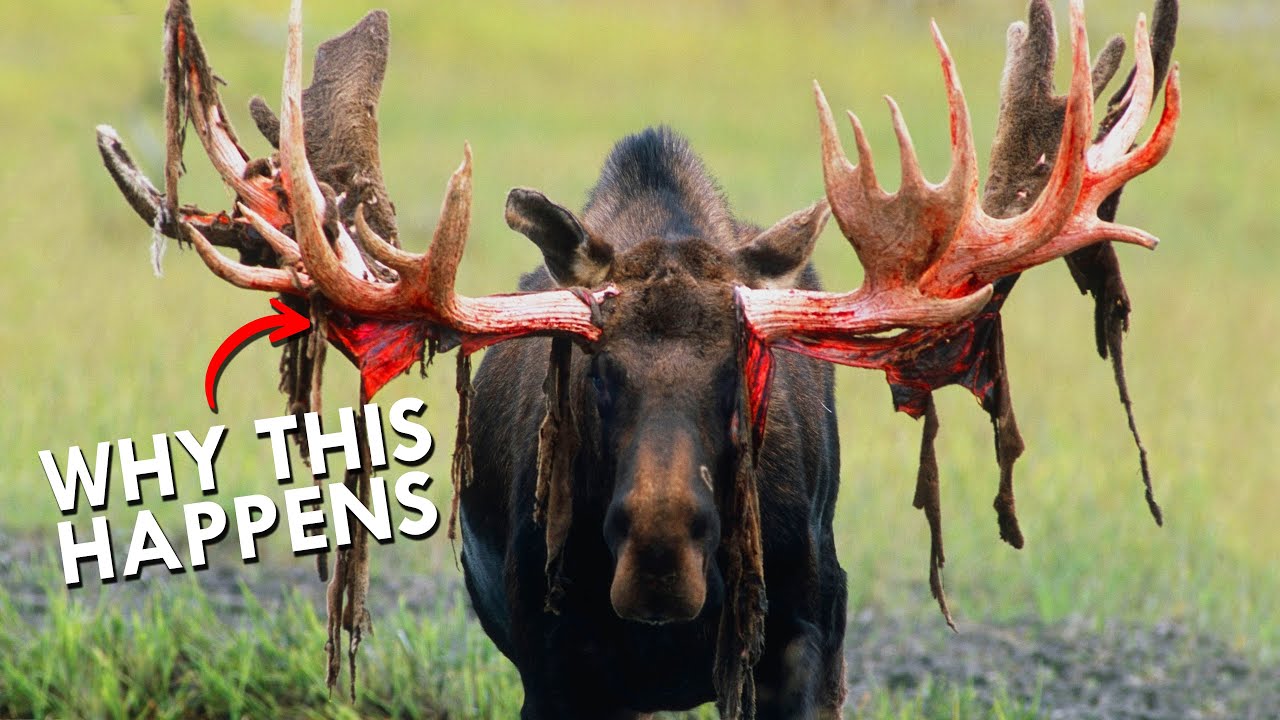
Velvet hangs in bloody strips from a bull moose

A dark bull moose faces the camera in a green field, red-streaked antlers reaching to both edges of the frame and strips of velvet hanging beside his face, with cut-off white lettering at the left edge.

Footage: Animalogic · 9:48 · uploaded February 7, 2023
Written by My Crittercam · published November 6, 2026

The Story

Both antlers run red, and the velvet that covered them hangs in strips past the eyes of a bull moose. He stares straight down the lens from a green field, a rag of his own skin dangling beside his muzzle.

The gore runs on a schedule. Minnesota DNR says antlers begin growing in April. Under that velvety skin, Maine's wildlife agency says, antler can grow as much as 8 inches in just nine days. Then testosterone surges in September and the velvet begins to shed, leaving bare antlers for the rut, which Minnesota puts at mid-September to mid-October, when bulls spar with them.

In one stretch of this film, a collection of old antlers sits around the crew, every one grown by the same bull, and that bull is standing right in front of them. One antler they handle still carries velvet, soft to the touch.

In December the crew stand near a bull whose velvet is already gone and give him days, maybe a week, before his rack comes off. Bulls drop their antlers in late fall or early winter after the rut to conserve energy for winter, usually in December and January by Minnesota's count. Elsewhere in the film a bull gives a shake and the antlers simply come away.

The day ends on a road in Jasper at sundown. A cow and calf cross, the cow looking both ways. Then a bull and a cow stand in the middle of the road, licking it. Moose seek mineral licks to replenish sodium reserves depleted in the winter. Natural licks are rare in Maine, where moose use salt runoff along roads, and these Jasper animals have come for salt too.

The tally climbs to five, then seven. Someone in the vehicle asks whether they have moose insurance. They do. By dark the count is nine, and another cow and calf are licking the road right in front of the vehicle, high beams on.
Field Guide

Bloody velvet peels from a bull moose's antlers, a bull shakes his rack off, and by dark moose are licking salt from a road in Jasper as the day's tally hits nine. Full field guide for the Moose

Common nameMoose
Scientific nameAlces alces
FamilyCervidae (Deer family)
SizeAdults stand on average 5 to 7 feet at the shoulder; total length about 9 feet (Maine).National Park Service · Maine Department of Inland Fisheries and Wildlife · Animal Diversity Web, University of Michigan
Weight800 lb (small adult female) to 1,600 lb (large adult male).Alaska Department of Fish and Game · Animal Diversity Web, University of Michigan
DietBrowser: leaves and shoots in summer, twigs of willow, birch and aspen in fall and winter, plus aquatic plants. Up to 70 lb of food a day.Animal Diversity Web, University of Michigan · Alaska Department of Fish and Game · National Park Service
Active whenCrepuscular: most active at dawn and dusk.Animal Diversity Web, University of Michigan · Maine Department of Inland Fisheries and Wildlife
RangeMuch of Alaska and Canada, the northern edge of the contiguous US, and south along the Rocky Mountains to Utah and Colorado.Animal Diversity Web, University of Michigan
LifespanRarely more than 16 years in the wild; one cow lived to 22.Alaska Department of Fish and Game · Animal Diversity Web, University of Michigan
Conservation statusIUCN Red List: Least Concern. NatureServe: G5; N5 in US and Canada.Animal Diversity Web, University of Michigan · NatureServe Explorer
Cam notes · Camerafilm crew camera, on foot and from a vehicle
Cam notes · Time of dayday into sundown and dark
Cam notes · SeasonDecember in one stretch, around October 15 on the road; the cover frame is green
Cam notes · PlaceJasper, Canada, for the field and road scenes

Habitat

Behavior

Questions

Why do moose lose their antlers?

Bulls drop their antlers in late fall or early winter, after the rut, to conserve energy for winter. Minnesota DNR says they are usually shed in December and January and begin growing again in April.National Park Service · Maine Department of Inland Fisheries and Wildlife · Minnesota Department of Natural Resources

Why do moose lick the road?

Moose seek mineral licks to replenish sodium reserves depleted in the winter. Natural salt licks are rare in Maine, so moose there are often seen along roads, using salt runoff as an artificial lick.National Park Service · Maine Department of Inland Fisheries and Wildlife

Are moose dangerous to people?

Moose usually flee, yet more people in Alaska are injured by moose than by bears yearly. They can become aggressive when harassed, when hungry and tired in deep winter snow, or as cows guarding calves, and rutting bulls may be too.Alaska Department of Fish and Game

Latest clips