My Crittercam
My Crittercam › American bison

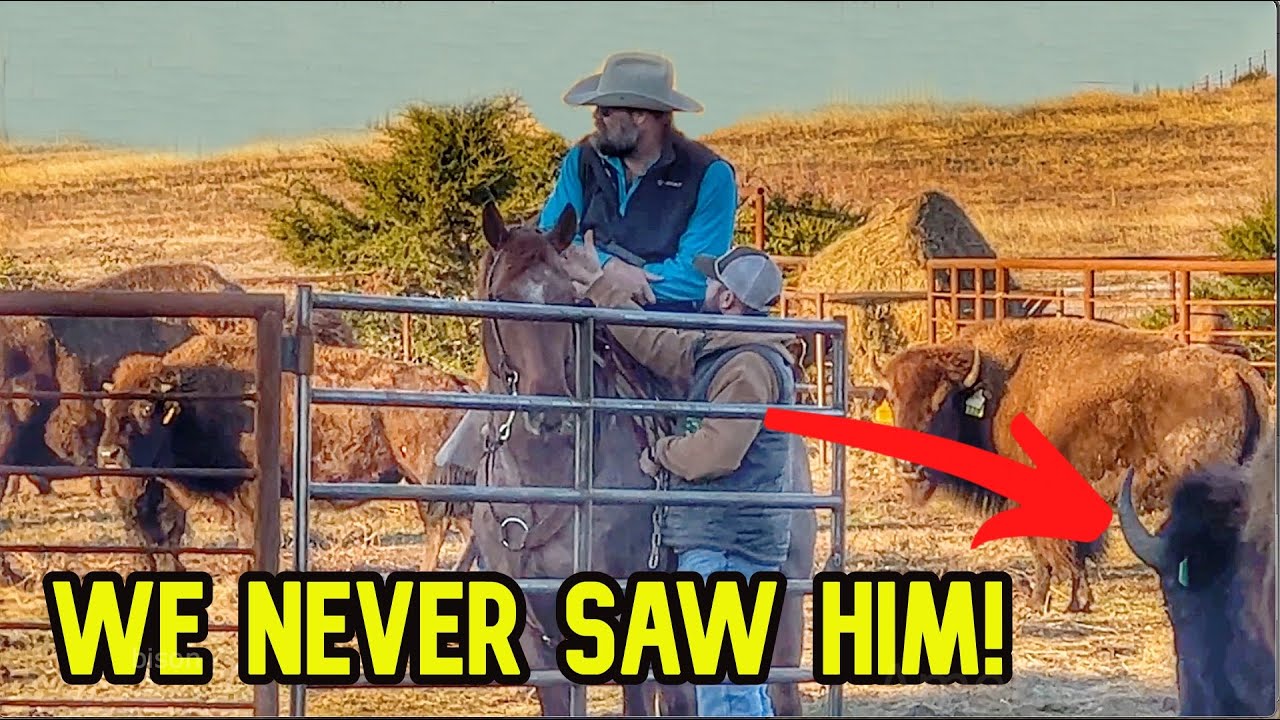
Tagged bison and a dark horn on fall working day

A brown American bison with a pale ear tag stands in a pen beyond a steel gate and rust-red panels, a red arrow pointing at a dark horn on the right edge, with a man in a cap and vest at left, a blue sleeve above him, a mound of hay behind and yellow letters reading W HIM across the bottom.

Footage: Cross Timbers Bison · 28:34 · uploaded December 10, 2023
Written by My Crittercam · published November 6, 2026

The Story

Three American bison bulls now share one Oklahoma pasture, and two of them should not be there. A gate opened for a skid steer, and they shot through behind it.

This is fall working day on a ranch running its largest herd so far, and the plan had three lines. One cow alone. Then the main herd, about 40 animals. Then the two bulls, penned to put on more weight after a busy summer and a drought. The skid steer with the hydraulic pusher had already failed to make the turn near the squeeze chute, and the crew had to shift freestanding panels.

A couple of years ago the ranch noticed the cow had lost a good part of her vision, and nobody knows why. She is healthy and she can still see, just not like the others, and mixed in with the herd she could get hurt. So she comes down alone. The scale reads 690 pounds, well under the 1,000 a cow can reach.

Then the bulls. A bull can reach 2,000 pounds, bison herds run on linear dominance hierarchies, and the animal can spin quickly and jump high fences, so steel panels carry only so much authority. The worried rancher calls hands off, no attempt to cut them out. When he looks up again, three of his crew have the pair split from the main herd. He does not know how they did it, and he does not ask. The two go down the chute and back to their pen.

That leaves the 40, and the harder job. Breaking a herd that size into small batches is hard going, and one of the crew suspects the horse, which the animals are not used to. The idea is a funnel: big pen, smaller pen, smaller still, then the alley and the chute. More freestanding panels would tighten it, the rancher says. For now the skid steer and its pusher go into the holding pen, and the light goes with the rest of the herd still unworked.
Field Guide

On a fall working day at an Oklahoma ranch, the crew works a cow with failing sight on her own, then two bison bulls slip through a gate to join a third. Full field guide for the American bison

Common nameAmerican bison
Scientific nameBison bison
FamilyBovidae (cattle, bison, antelope and goats)
WeightBulls up to 2,000 pounds; cows up to 1,000 pounds (Yellowstone).National Park Service (Yellowstone National Park)
SizeMature bulls can reach 5.5 to 6.5 ft (1.9 m) at the hump and 9 to 12.5 ft (2.7 to 3.8 m) long; cows are normally 5 ft (1.5 m) high and 7 to 10 ft (2.2 to 3.2 m) long.Smithsonian's National Zoo and Conservation Biology Institute
DietYellowstone bison: more than 90% grasses, sedges and other grass-like plants; forbs and browse usually under 5%.National Park Service (Yellowstone National Park)
RangeOnce Alaska to northern Mexico; now found on private and protected lands in areas of the western United States and Canada.Animal Diversity Web, University of Michigan
Active whenPrimarily diurnal, especially early morning and late afternoon, with grazing periods between loafing and ruminating.NatureServe Explorer
Lifespan15 to 20 years in the wild; up to 40 years recorded in captivity.Animal Diversity Web, University of Michigan
Conservation statusIUCN Red List: Near Threatened; NatureServe Global Rank G4. COSEWIC (Canada): Plains Bison Threatened, Wood Bison Special Concern.NatureServe Explorer
Cam notes · Cameraground cameras plus drone
Cam notes · Time of dayday
Cam notes · Seasonfall
Cam notes · Placea bison ranch in Oklahoma

Habitat

Behavior

Questions

How much does a bison weigh?

Bison are the largest land mammal in North America. Bulls weigh up to 2,000 pounds and cows up to 1,000 pounds.National Park Service (Yellowstone National Park)

Are bison dangerous to people?

Bison have injured more people in Yellowstone than any other animal. The park says to stay at least 25 yards (23 meters) away and never approach one for a photo.National Park Service (Yellowstone National Park)

How can you tell if a bison is calm or upset?

A tail hanging down and switching usually means calm, while a tail standing straight up is a warning. Other warning signs include bluff charging, head bobbing while staring, pawing and bellowing.National Park Service (Yellowstone National Park) · U.S. Department of the Interior

Latest clips