My Crittercam
My Crittercam › American bison

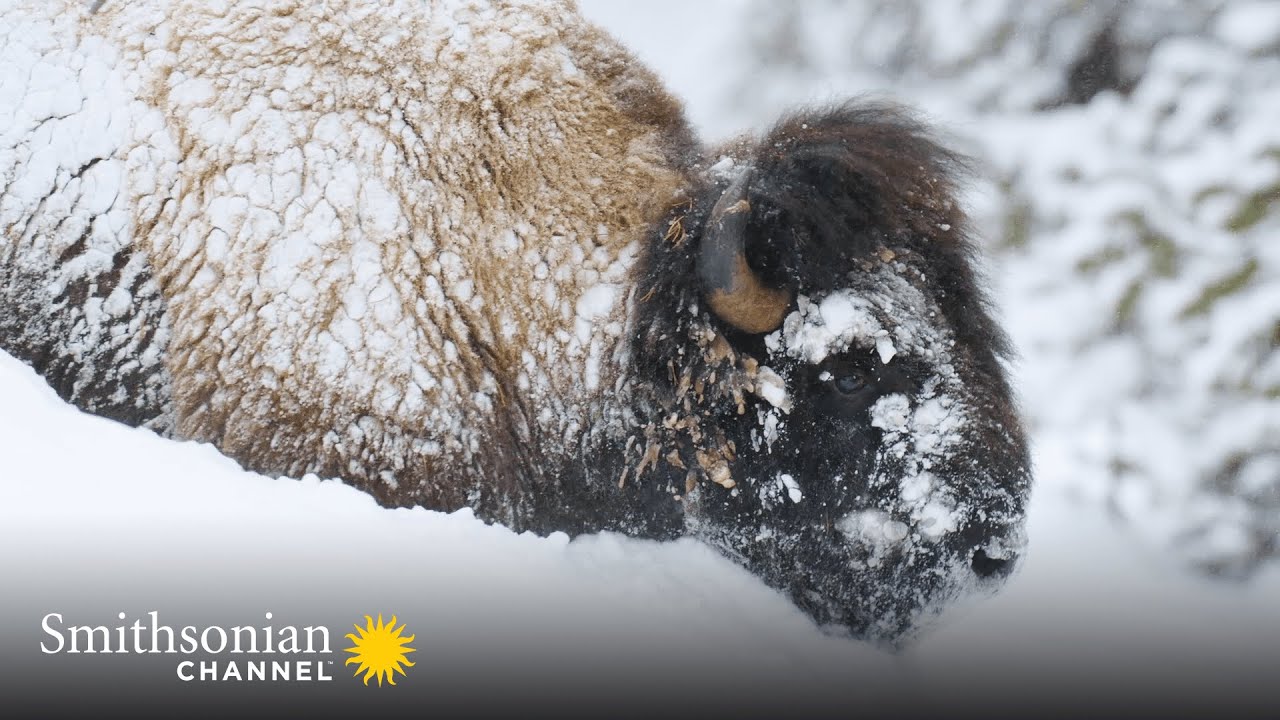
Snow-caked bison in a Yellowstone blizzard

Close-up of an American bison's dark, shaggy head in profile, snow caked over the brow and muzzle, one horn and one eye showing, a snow-crusted shoulder at left and a drift below.

Footage: Smithsonian Channel · 4:01 · uploaded January 27, 2021
Written by My Crittercam · published November 6, 2026

The Story

Snow has packed itself into the face of an American bison, over the brow, around the horn, in a white clump just above one dark eye. It is a Yellowstone blizzard, and the animal keeps working.

The head does the heavy lifting. A bison carries that skull on a hump of shoulder and neck muscle, and in deep snow it swings the head side to side to clear a patch down to the grass. This is a grazer through and through: Yellowstone bison get more than 90 percent of their diet from grasses, sedges and other grass-like plants, and typically forage 9 to 11 hours a day. In a blizzard, every mouthful starts as a shovel job.

Look at the coat. Snow settles on the back and sits there in cracked plates. Underneath are thick skin and underfur, long guard hairs and layers of fat, insulation for a body that weighs up to 2,000 pounds in a bull and 1,000 in a cow.

That a herd is here at all comes down to a narrow escape. Bison once ranged from Alaska to northern Mexico, an estimated 30 to 100 million of them before 1800. By the 1890s fewer than 1,000 were left, and poachers cut Yellowstone's wild herd to about two dozen by 1902. Those last animals held out in a remote valley deep in the park. That same year the U.S. Army brought in 21 bison from two private herds, which later mixed with the wild ones. Bison have lived in Yellowstone continuously since prehistoric times.

Then the snow gets too deep to dig. A cow at the front gives the signal, and the bison fall into line behind her. Traveling herds take that shape, a line with an adult cow at its head. As the light fades, the column follows her trail out of the valley toward the warmer heart of the park. It is the first step of a migration, and Yellowstone bison migrate up to 70 miles between summer and winter ranges.
Field Guide

In a Yellowstone blizzard, snow-caked bison clear drifts with their heads to reach buried grass until a lead cow takes the herd out of the valley. Full field guide for the American bison

Common nameAmerican bison
Scientific nameBison bison
FamilyBovidae (cattle, bison, antelope and goats)
SizeMature bulls can reach 5.5 to 6.5 ft (1.9 m) at the hump and 9 to 12.5 ft (2.7 to 3.8 m) long; cows are normally 5 ft (1.5 m) high and 7 to 10 ft (2.2 to 3.2 m) long.Smithsonian's National Zoo and Conservation Biology Institute
WeightBulls up to 2,000 pounds; cows up to 1,000 pounds (Yellowstone).National Park Service (Yellowstone National Park)
DietYellowstone bison: more than 90% grasses, sedges and other grass-like plants; forbs and browse usually under 5%.National Park Service (Yellowstone National Park)
Active whenPrimarily diurnal, especially early morning and late afternoon, with grazing periods between loafing and ruminating.NatureServe Explorer
RangeOnce Alaska to northern Mexico; now found on private and protected lands in areas of the western United States and Canada.Animal Diversity Web, University of Michigan
Lifespan15 to 20 years in the wild; up to 40 years recorded in captivity.Animal Diversity Web, University of Michigan
Conservation statusIUCN Red List: Near Threatened; NatureServe Global Rank G4. COSEWIC (Canada): Plains Bison Threatened, Wood Bison Special Concern.NatureServe Explorer
Cam notes · Cameradocumentary footage (Epic Yellowstone: Fire and Ice)
Cam notes · Time of dayday
Cam notes · Seasonwinter, blizzard
Cam notes · PlaceYellowstone National Park

Habitat

Behavior

Questions

How do bison stay warm in a blizzard?

Their winter insulation comes from thick skin and underfur, long guard hairs, and layers of fat. That heavy coat is shed in spring, when bison roll to loosen the hair and it falls off in gobs.National Park Service (Yellowstone National Park) · Smithsonian's National Zoo and Conservation Biology Institute

Who leads a bison herd when it moves?

Bison herds have linear dominance hierarchies. When they travel, they form a line led by an adult cow.Animal Diversity Web, University of Michigan

How many bison were there, and how many now?

Estimates before 1800 ranged from 30 to 100 million, falling below 1,000 by the 1890s. About 30,000 are in conservation herds and about 500,000 are managed as livestock.Smithsonian's National Zoo and Conservation Biology Institute

Latest clips