The Story
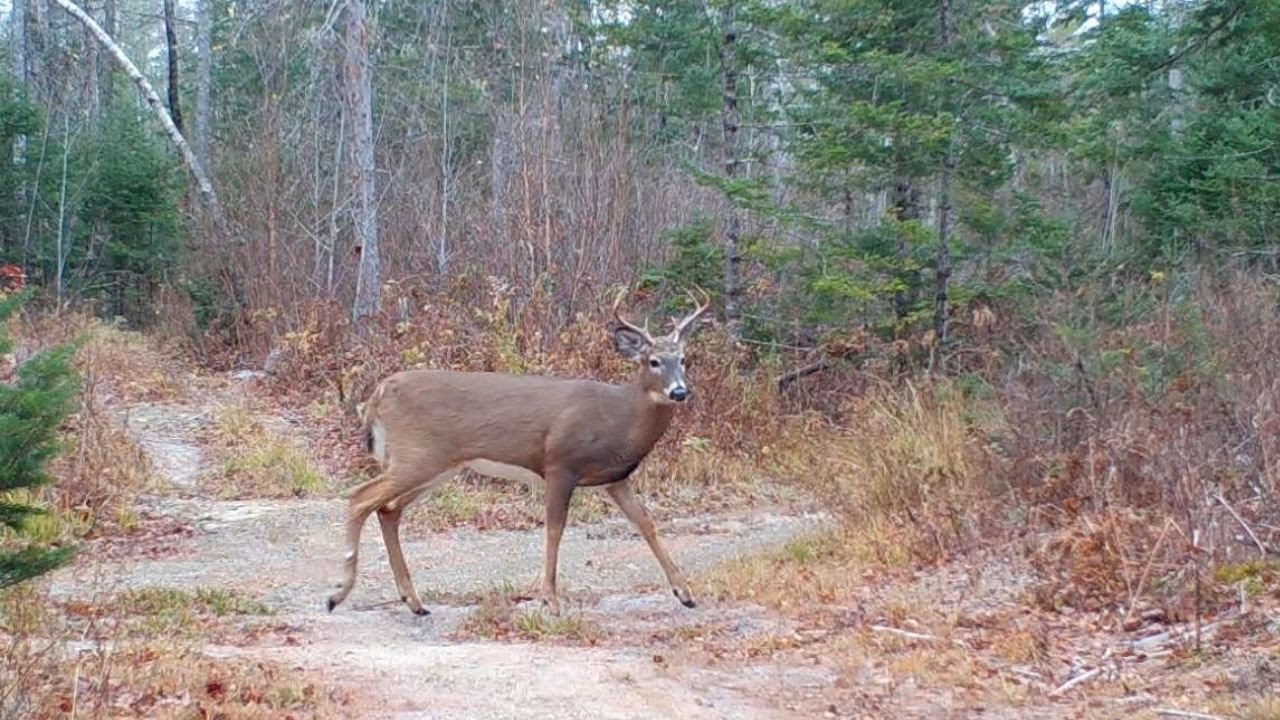
On an ATV track behind a house in Penobscot County, Maine, a white-tailed buck crosses the gravel in broad daylight, turning his head toward the trail camera mid-stride, a quick check on the way across. It is the week ending November 6, the leaves are down, and the rut is under way.
He wears a branched rack, upswept and fairly narrow, and the gray-brown coat of a deer already dressed for winter. White marks the band behind his black nose and the patch at his throat. Summer's reddish-brown coat gives way each fall to long, thick, grayish hairs; in Maine the molt comes in September, laying dense woolly underfur beneath long, hollow guard hairs that can stand up for extra warmth.
White-tails are typically most active at dawn and dusk, but in the breeding season their activity may increase through the day, and Maine's peak arrives in mid-November. Bucks rub their antlers on trees and paw scrapes beneath a licking branch, leaving gland scent as messages. A doe is receptive for only about 24 hours, and if she is not bred she cycles back every 28 days until early winter. Rivals settle access to her by clashing antlers; no buck keeps a harem.
Antlers grow in velvet from spring, harden by fall, and in Maine they drop between late December and early March. Not every Maine deer migrates, but those that do typically move to winter cover between mid-November and January, mainly closed-canopy softwood stands of cedar, hemlock, fir and spruce that intercept snow. By late fall, stored fat can make up 10 to 25 percent of a deer's body weight.
Five fixed cameras cover these paths and game trails, and over the week they log plenty of deer, a coyote, and a much bigger buck, wide through the rack. Partway through, snow whitens the trails, and the cameras read 27 degrees. The big fellow does most of his traveling after dark; it is the narrower rack that crosses the gravel in full light.