The Story
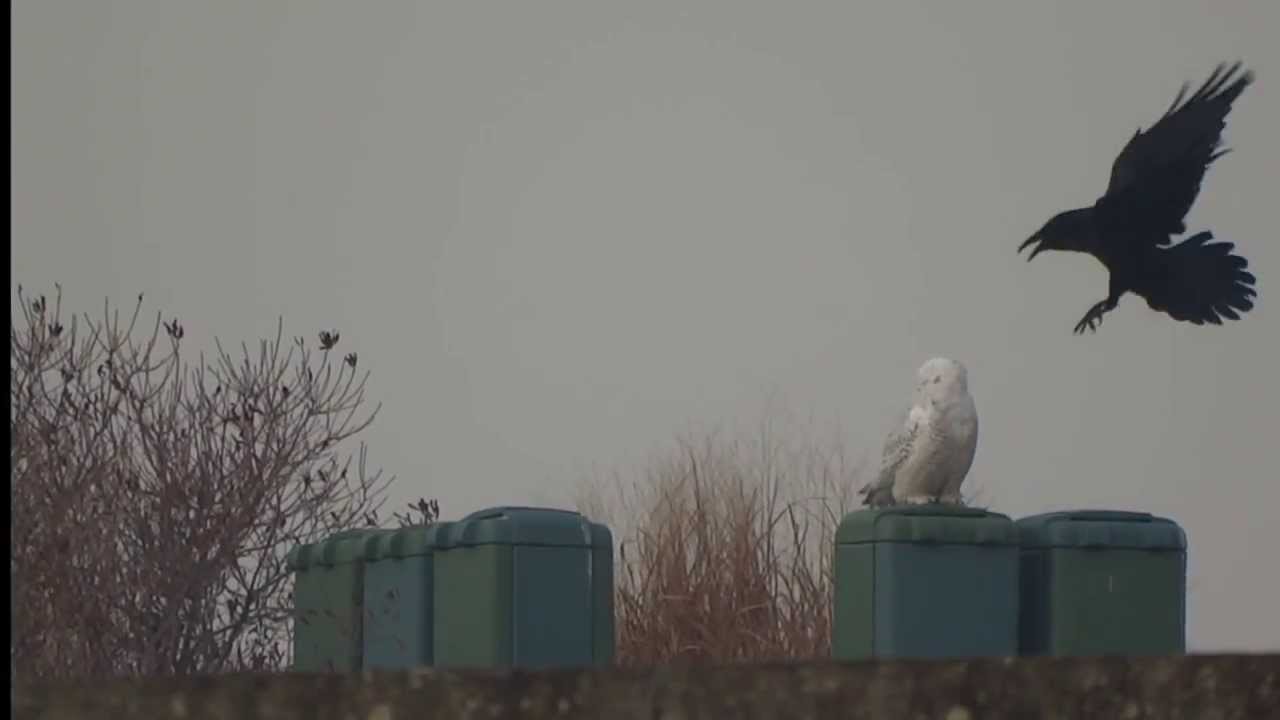
A common raven drops out of a flat grey sky, beak open and feet reaching, toward a snowy owl parked on a green bin on a golf course. The owl stays put, unimpressed.
The meeting is lopsided. Snowy owls are big, round-headed white owls with yellow eyes and very small ear tufts that are hard to see, and this one is flecked with dark barring across its back and wings. Ravens are black from bill to feet, with a thick neck and shaggy throat feathers. One bird sits. The other cannot keep still.
Naturalist Bernd Heinrich, author of The Mind of the Raven, read the encounter for the filmer. The owl, he wrote, is totally unimpressed and not scared in the least. The raven has no aggressive intentions. It starts out curious and tests the owl, angling for any reaction at all. More than once the owl answers by swiveling its head toward the camera instead.
So the raven tries a different approach. It raises its "ear" feathers, a display Heinrich says ravens use to show status around potential superiors, and pairs it with bowing and wing-flaring, gestures of supplication when no challenge is coming. His verdict: the raven was having fun, and starting to show some respect for a big white thing that would not be its toy.
Play is ordinary raven behavior. Ravens go belly-sliding down inclines and drop and catch objects in flight. At carcasses a raven may pull at a wolf's tail or an eagle's feathers, staying just out of harm's way, and ravens also peck and pull the tails of eagles and wolf pups. Ravens also compete with snowy owls for lemmings.
The owl's composure has its own logic. Snowy owls breed on Arctic tundra and winter in open country, and in winter Project SNOWstorm says snowy owls are active primarily at night, and field observers find them fairly inactive by day. Late in the clip, with the raven out of the shot, the owl at last opens its wings over the green bins.