The Story
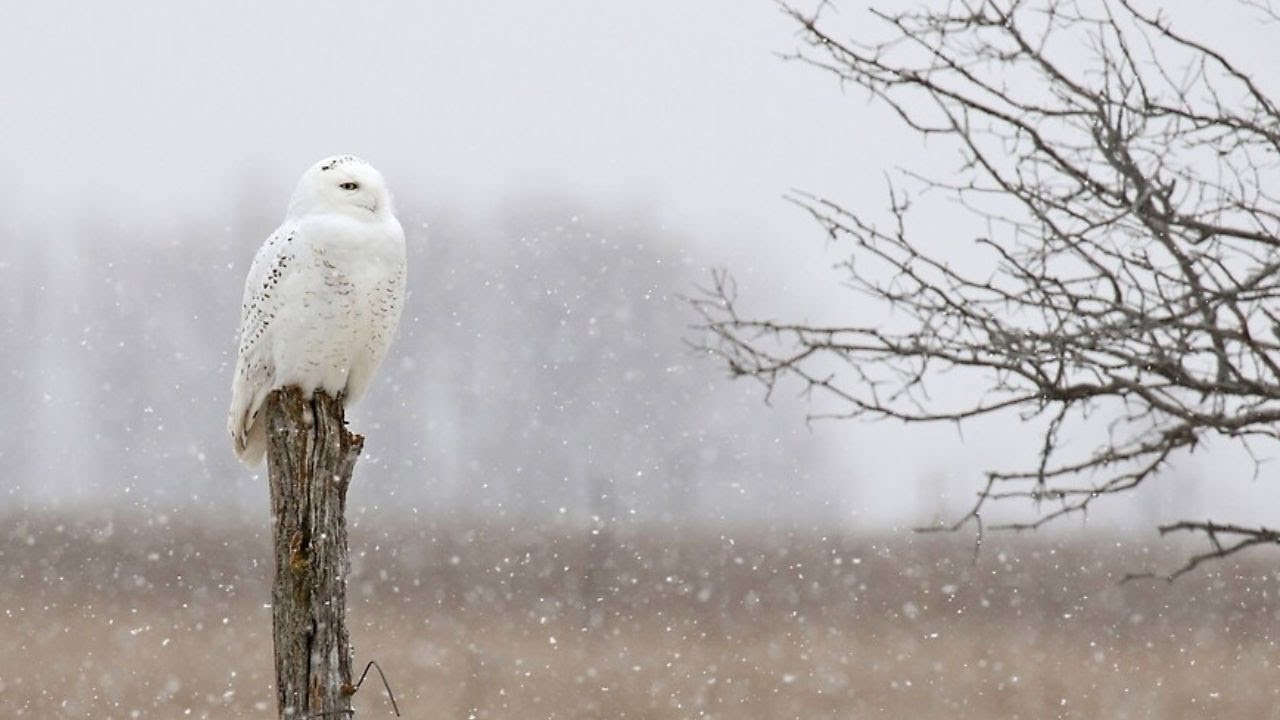
A male snowy owl sits on a weathered wooden post above a Canadian field, white against a white sky. Below him, the ground is alive with voles.
This was an eruption year for voles in this spot. They show in the field, at the filmer's feet, as tracks pressed into the mud, and running across the road. He was the nearest of the owls to that road, so the whole day could be filmed without a step into the field. For a bird whose menu runs to lemmings, voles, mice, rabbits and hares, the table is laid edge to edge.
Snowy owls usually hunt from a perch, then chase prey in swift flight and take it in the talons. They find it by sight or by sound, and can pinpoint a rodent moving under snow by hearing. A post above a crowded field is the textbook setup, and for the first hours he sits on it and takes the field in.
Nothing in the account of the day has him making a catch. In winter Project SNOWstorm says snowy owls are active primarily at night and fairly inactive by day. Its Scott Weidensaul says they are more active, and earlier in the afternoon, on gloomy, cloudy days. This day ran through nearly every kind of weather.
He is close to white, with a scatter of dark flecks on the wings. Males have the least dark marking, and the Owl Research Institute says it takes males several years to turn totally white. A female he regularly roosts with makes a short appearance. Close to 25 snowy owls were counted on the same ground, a crowd for a species that is generally solitary and territorial, and whose females set up winter territories they defend until spring.
The day ends in heavy snow. White plumage hides a snowy owl in snow-covered country, and its legs and feet are wrapped in feathers, layered more densely than in owls of warmer climates. Snow blurs the field behind him, and he stays on the post.