The Story
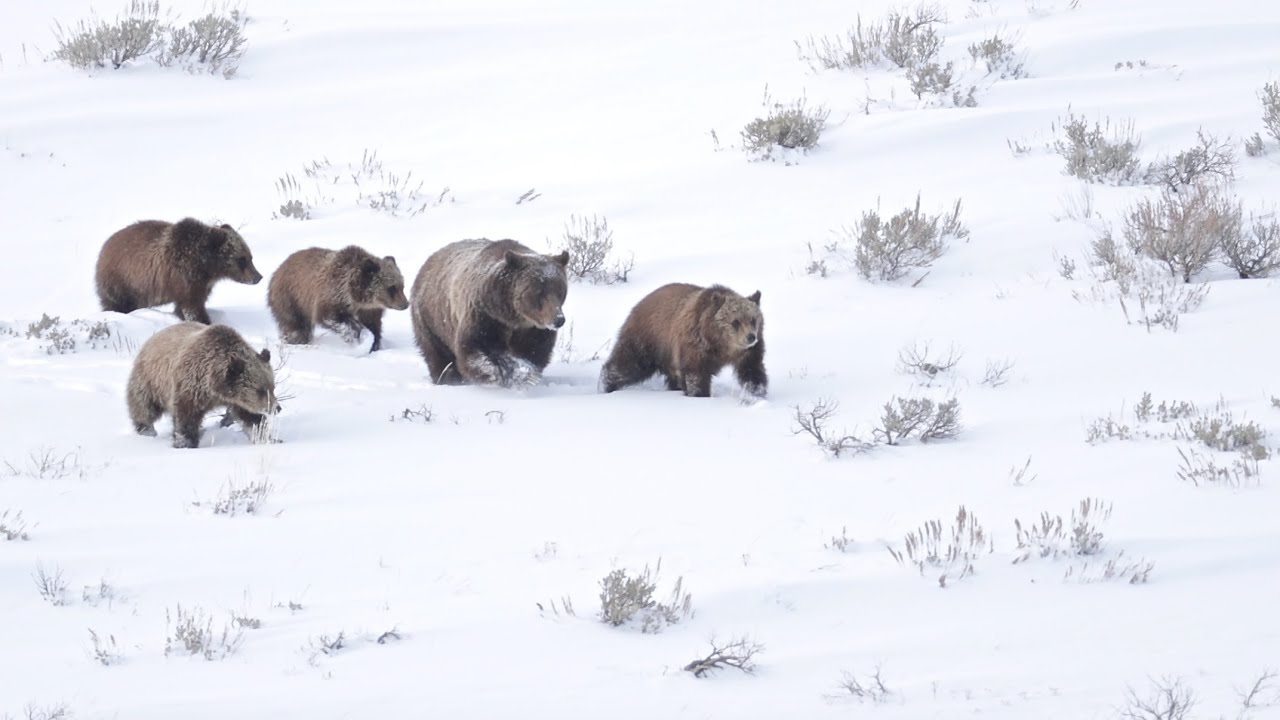
Grizzly bear 399 plows across a snowfield, cubs strung out around her, three behind and one already out in front. The family is walking north, and the end of the walk is a winter den.
The sow is the big one in the middle. Grizzlies carry a hump of muscle over the shoulders, more prominent than a black bear's, and a dished face profile. The cubs are no longer small. Each already looks like a scaled-down copy of her, and one trails at the back of the line.
Four is a lot of bear to raise. The average grizzly litter is about two, and in Alaska litters run from one to four, so 399 has a family at the very top of that range. Grizzly families typically stay together for two or three years, and in Alaska fewer than half survive. A female can take ten years or more to replace herself, one of the slowest reproductive rates among land mammals.
The trip fits the season. Lower-48 grizzlies den for four to six months, typically going in between October and December; males go in later than females and, on average, come out earlier. Before that comes autumn hyperphagia, when a bear can gain more than three pounds a day. In Greater Yellowstone, dens are typically dug into slopes of 30 to 60 degrees, often north-facing, where wind-drifted snow piles on as insulation, and the digging typically takes three to seven days.
What happens inside is the real feat. The bears do not eat, drink, urinate or defecate. Breathing slows to one breath every 45 seconds and the heart to 8 to 19 beats a minute, yet body temperature stays within 12°F of normal. A bear can come out 15 to 30 percent lighter than she went in.
The footage stops short of the entrance, so the den itself stays a secret. Five bears, one den. Finding room for the cubs is her problem.