The Story
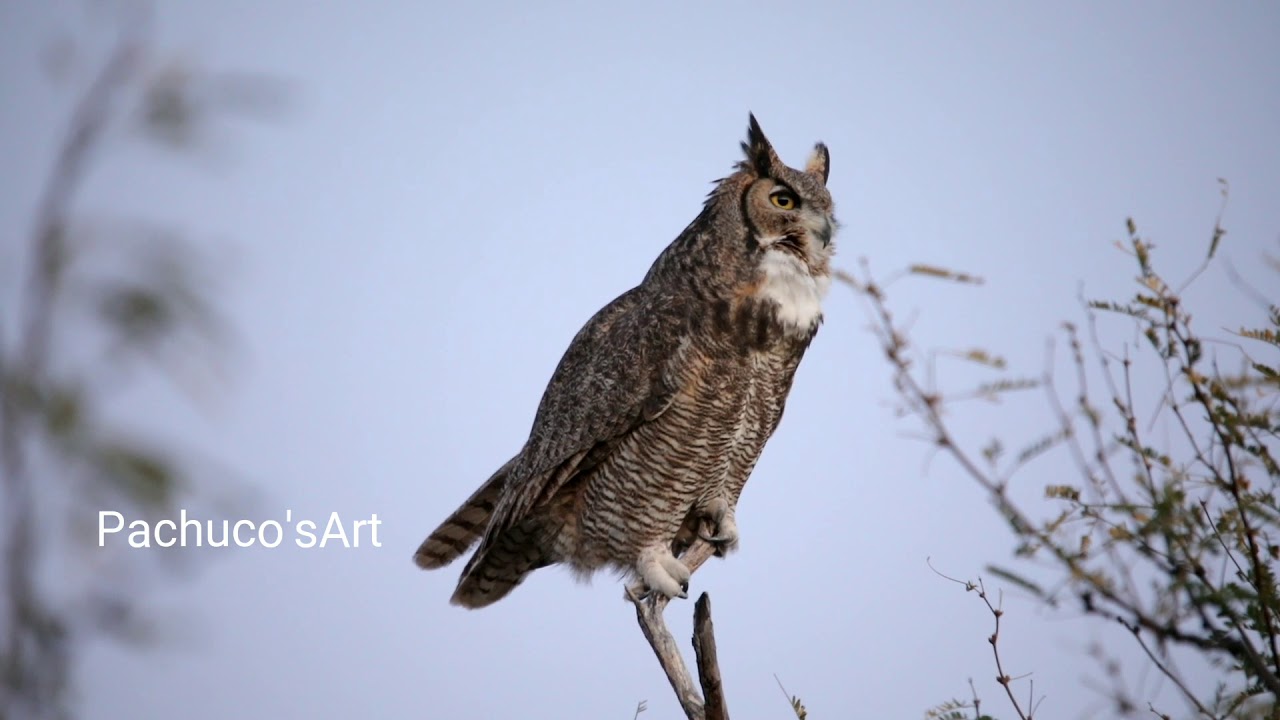
A great horned owl stands on the broken tip of a bare branch, ear tufts raised, white throat bright against a pale desert sky. It sends low hoots out over the brush.
It is still light, which is a gift. This is a bird that hunts mostly at night, and a pair trading calls is often heard on dark winter evenings or before dawn. Here the whole exchange happens in the open, yellow eyes and barred belly in plain view.
Those hoots are built to carry. The species' song is a run of low, far-carrying notes, hoo, hoo-hoo, hoo, hoo, the second and third notes shorter. In a duet the female usually opens and the male answers at a lower pitch, and the two may call back and forth or overlap. The calling does real work: breeding pairs hold territories, and hooting mainly sets where one pair's ground ends.
Early on, the owl lets a dropping fall from the perch. Courtship, apparently, makes room for housekeeping.
Then the call is answered in person. Near the end a second owl flies in, and the pair mate on the spot, over in a few seconds.
That calling belongs to a long breeding calendar. Great horned owls breed between November and April, nesting later at higher latitudes, and in the north they may start in late winter. They build little themselves. A pair typically takes over an old hawk, eagle, crow or heron nest 20 to 60 feet up, or settles on a cliff ledge or in a cave. The usual clutch is two or three eggs, and the female does most of the 28 to 35 days of incubation.
Desert is no stretch for this owl, which turns up in nearly every North American habitat, from swamps to deserts to northern conifer forest near treeline. At nesting time it needs some trees or heavy brush for cover, and the brush at the edges of this frame qualifies.