My Crittercam
My Crittercam › Canada lynx

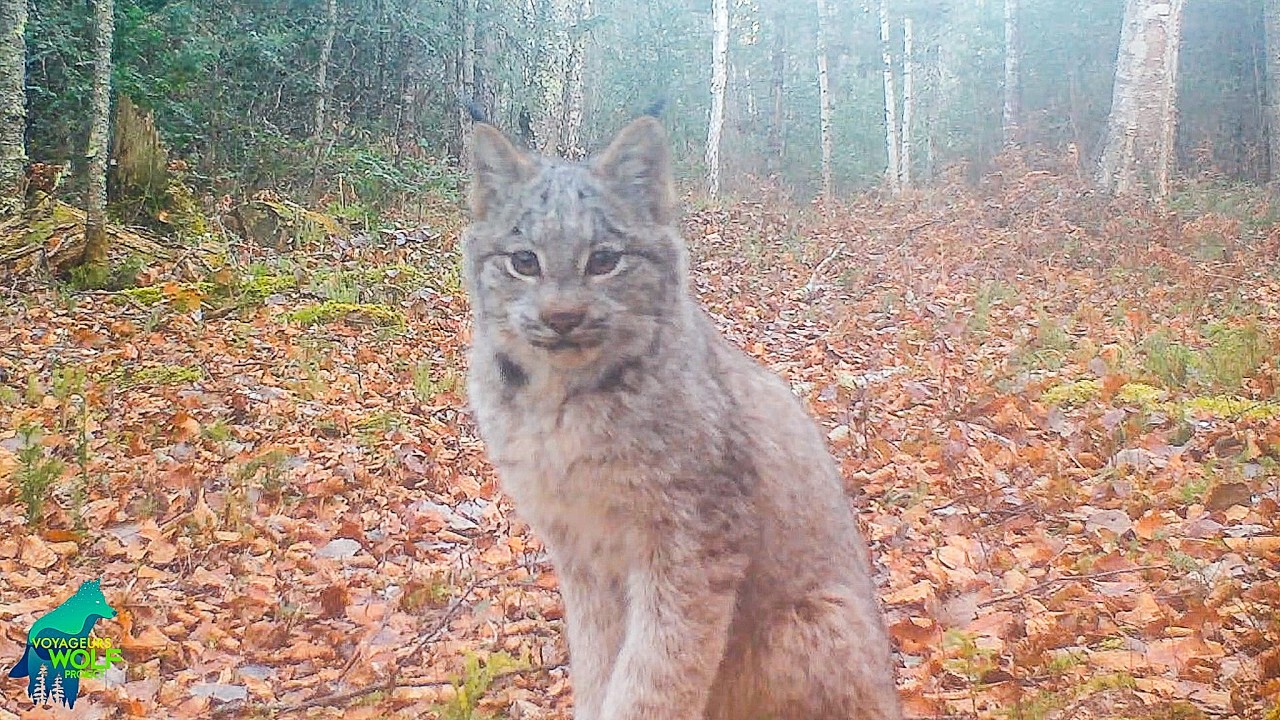
Canada lynx sits for a trail cam in fall leaves

A grizzled gray Canada lynx with short black ear tufts sits upright facing the camera on a forest floor of fallen orange leaves, pale birch trunks and misty woods behind it.

Footage: Voyageurs Wolf Project · 0:43 · uploaded October 16, 2026
Written by My Crittercam · published November 6, 2026

The Story

A Canada lynx sits close to a trail camera in Voyageurs National Park, black ear tufts up, and in the same orange leaves two lynx, one smaller than the other, walk off together. On its own, the close-up is a fine portrait. In context, a small piece of history.

This cat belongs to a trio: a female and two kittens, the first lynx kittens ever documented in Minnesota's only national park. The Voyageurs Wolf Project filmed the family in November, February and on the last day of March, and both kittens likely reached their first birthday.

A National Park Service study from 2000 to 2004 found one male and one female in the park and called lynx transient or scarce. A 2007-2008 survey using trail cameras and snow tracking found none in or around the park, and concluded that hares across the wider landscape were too sparse to support resident lynx. By 2015, park researchers still saw no sign of residents.

Snowshoe hare abundance is the major limiting factor for lynx, so the old surveys were reasoning from the right animal. When hares run short, kitten deaths climb and pregnancy rates fall, and a lean stretch can kill nearly all the young. This mother likely brought two kittens through a Minnesota winter anyway, something biologists were not sure the park could support.

Long black ear tufts and a grizzled gray coat set a lynx apart from a bobcat, which runs redder with distinct black spots. The paws earn their keep in winter: large, broad feet work as snowshoes in deep powder, likely giving lynx a seasonal edge over other terrestrial hare predators.

Kittens stay with their mother until the next winter's mating season, and this trio was still together on the last day of March. In the snow footage two lynx come down a white forest track toward the camera, and one walks right past it, broad furry paws pressing into the snow.
Field Guide

A Canada lynx sits facing a trail camera in autumn leaves in Voyageurs National Park, one of a mother and two kittens that make up the first lynx family documented there. Full field guide for the Canada lynx

Common nameCanada lynx
Scientific nameLynx canadensis
FamilyFelidae (cats)
Size30 to 35 in (75 to 90 cm) long; tail 50 to 130 mmU.S. Fish & Wildlife Service · Animal Diversity Web, University of Michigan Museum of Zoology
Weight15 to 30 pounds (6 to 14 kilograms); males slightly heavier than femalesU.S. Fish & Wildlife Service · Animal Diversity Web, University of Michigan Museum of Zoology
DietCarnivore; snowshoe hares make up 35-99% of prey biomass, plus rodents, birds, fish and carrionUSDA Forest Service · Animal Diversity Web, University of Michigan Museum of Zoology
Active whenMost active between dusk and dawn; hides during the dayUSDA Forest Service
RangeBoreal forest across most of Canada and Alaska; in the contiguous US, resident breeding populations in northern Maine/New Hampshire, NE Minnesota, NW Montana/N Idaho, N-central Washington, western ColoradoU.S. Fish & Wildlife Service
LifespanUp to 14.5 years in the wild; 26.75 years recorded in captivityAnimal Diversity Web, University of Michigan Museum of Zoology
Conservation statusIUCN Red List: Least Concern; NatureServe: G5 (Secure); COSEWIC: Not at Risk; US Endangered Species Act: Threatened (contiguous US distinct population segment, listed 2000)Animal Diversity Web, University of Michigan Museum of Zoology · NatureServe Explorer · U.S. Fish & Wildlife Service
Cam notes · Cameratrail camera
Cam notes · Time of dayday
Cam notes · Seasonobservations in November 2025, February 2026 and March 31, 2026
Cam notes · PlaceVoyageurs National Park, Minnesota

Habitat

Behavior

Questions

Is this a lynx or a bobcat?

A lynx tail tip is black all the way around, while a bobcat's is black only on top with a white underside. Lynx also have longer ear tufts, much larger paws and longer hind legs.Minnesota Mammals, Natural Resources Research Institute, University of Minnesota Duluth · Alberta Institute for Wildlife Conservation · U.S. Fish & Wildlife Service

Why do lynx have such big paws?

Large, broad feet work as snowshoes for winter hunting and travel; with long hind legs they suit hunting hares in deep, powdery snow and likely give lynx a seasonal edge over other terrestrial hare predators. Long, thick fur keeps the toes warm in winter, and hair on the soles gives traction on slippery surfaces.Alaska Department of Fish and Game · U.S. Fish & Wildlife Service · San Diego Zoo Wildlife Alliance

Do lynx really live in Minnesota?

The US range of the Canada lynx includes northeastern Minnesota, along with parts of Maine, New Hampshire, Montana, Idaho, Washington and Colorado. In the contiguous US the lynx was listed as threatened under the Endangered Species Act in 2000.U.S. Fish & Wildlife Service

Latest clips