My Crittercam
My Crittercam › Moose

Bull moose shakes off both antlers in the snow

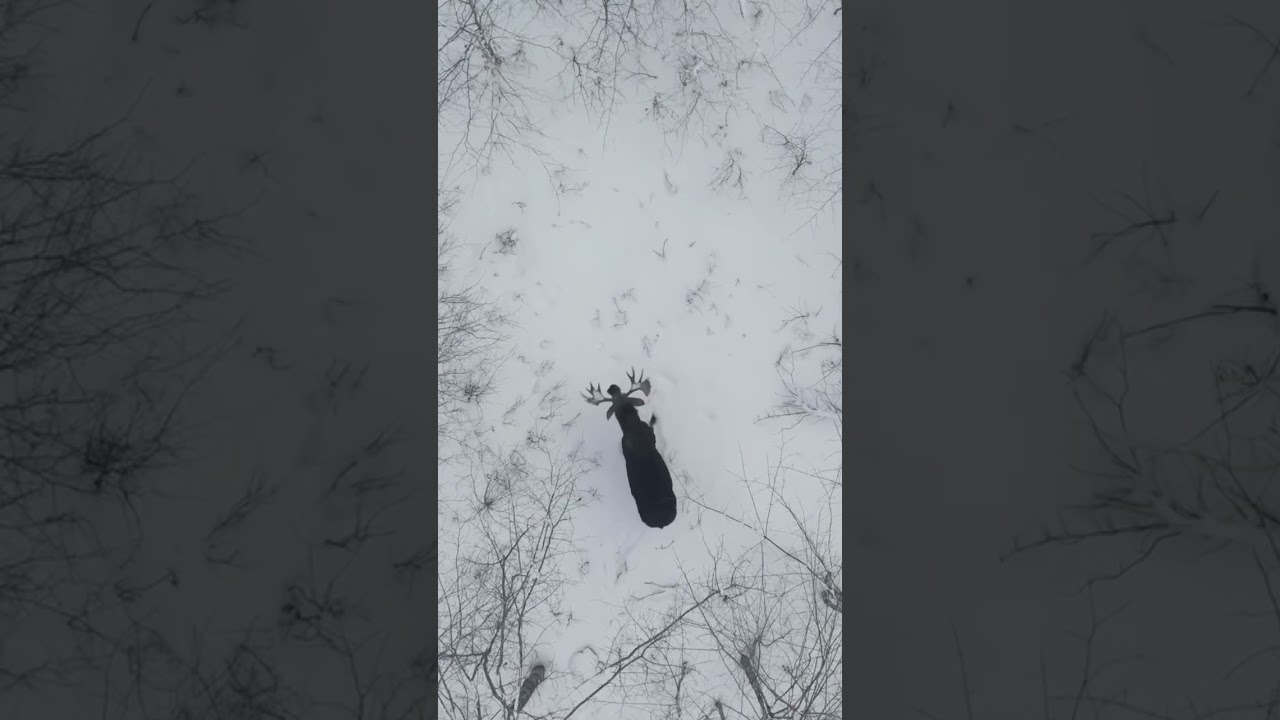
Overhead view of a dark bull moose with antlers still on, standing in snow among thin, bare trees.

Footage: Adventures In The Wild · 0:11 · uploaded January 15, 2023
Written by My Crittercam · published November 6, 2026

The Story

A bull moose stands alone in the snow, seen from straight above, antlers still riding on his head. A few seconds later both of them are lying in the snow and he is gone.

The camera looks down through bare branches onto a small opening among thin, leafless trees. The bull is a dark block against the white. Alone is normal for him; moose are the least social of the deer. Then he shakes. Not a toss of the head but the whole body, and the antlers come away.

This is the calendar at work. Bulls drop their antlers in late fall or early winter, after the rut, to conserve energy for the cold months, and they are usually shed in December and January. Bulls spar with them through the rut, which Minnesota DNR puts at mid-September to mid-October. After that the rack is a cost, and a big bull's palmate pair can reach five feet across and, by the National Park Service's figure, weigh up to 77 pounds.

The exit is the part that makes the clip. The instant the antlers hit the snow, the bull is off at a run. He has the legs for a quick exit; moose can run 35 miles an hour. The footage gives no reason for the hurry.

He will be bare-headed only until spring. New antlers begin growing in April, covered in velvet, and antler can grow as much as 8 inches in nine days. In September the velvet sheds as testosterone surges, and the bull walks into the next rut fully armed again.

Until then he has a winter to get through. Long legs let a moose paw down through deep snow to reach food, and the fall and winter menu is twigs of willow, birch and aspen, eaten in large quantities. The pair in the snow behind him is last season's growth, finished with.
Field Guide

Filmed from directly above, a lone bull moose in a snowy forest shakes loose both antlers and runs the moment they fall. Full field guide for the Moose

Common nameMoose
Scientific nameAlces alces
FamilyCervidae (Deer family)
SizeAdults stand on average 5 to 7 feet at the shoulder; total length about 9 feet (Maine).National Park Service · Maine Department of Inland Fisheries and Wildlife · Animal Diversity Web, University of Michigan
Weight800 lb (small adult female) to 1,600 lb (large adult male).Alaska Department of Fish and Game · Animal Diversity Web, University of Michigan
DietBrowser: leaves and shoots in summer, twigs of willow, birch and aspen in fall and winter, plus aquatic plants. Up to 70 lb of food a day.Animal Diversity Web, University of Michigan · Alaska Department of Fish and Game · National Park Service
RangeMuch of Alaska and Canada, the northern edge of the contiguous US, and south along the Rocky Mountains to Utah and Colorado.Animal Diversity Web, University of Michigan
Active whenCrepuscular: most active at dawn and dusk.Animal Diversity Web, University of Michigan · Maine Department of Inland Fisheries and Wildlife
LifespanRarely more than 16 years in the wild; one cow lived to 22.Alaska Department of Fish and Game · Animal Diversity Web, University of Michigan
Conservation statusIUCN Red List: Least Concern. NatureServe: G5; N5 in US and Canada.Animal Diversity Web, University of Michigan · NatureServe Explorer
Cam notes · Time of dayday
Cam notes · Seasonwinter, snow on the ground

Habitat

Behavior

Questions

Why do moose shed their antlers?

Bulls drop their antlers in late fall or early winter after the rut to conserve energy for winter. During the rut, which Minnesota DNR puts at mid-September to mid-October, bulls spar with them.National Park Service · Maine Department of Inland Fisheries and Wildlife · Minnesota Department of Natural Resources

How heavy are moose antlers?

The National Park Service says a bull's palmate antlers can reach five feet across and weigh up to 77 pounds; Minnesota DNR gives up to 40 pounds. Bulls carry them from spring growth until they are usually shed in December and January.National Park Service · Minnesota Department of Natural Resources

Do moose antlers grow back?

Yes, new antlers begin growing in April, covered in velvet. Antler can grow as much as 8 inches in nine days, and the velvet sheds as testosterone surges in September.Minnesota Department of Natural Resources · Maine Department of Inland Fisheries and Wildlife

Latest clips