My Crittercam
My Crittercam › American black bear

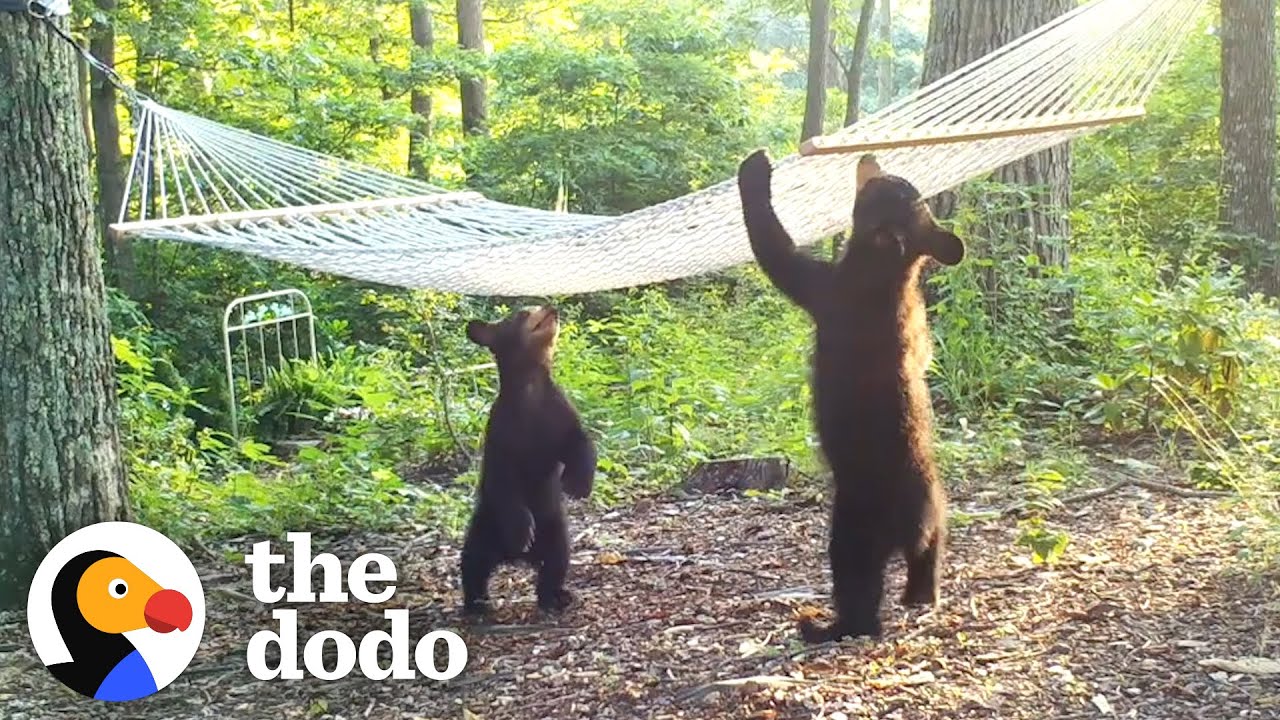
Black bear cub stands tall to grab a hammock

A black bear cub stands on its hind legs on leaf litter, one front paw raised against the white rope netting of a hammock, nose tipped up toward its wooden spreader bar, green woods behind.

Footage: The Dodo · 3:05 · uploaded January 9, 2021
Written by My Crittercam · published November 6, 2026

The Story

Two black bear cubs stand bolt upright beneath a backyard hammock. The bigger one reaches a paw up to the netting, and the smaller one tips its nose up at it as if working out the physics.

A woman bought the hammock for the bear family that comes by her house, a mother and two cubs, and a critter cam in the yard records what they make of it. Many bear families have passed through.

Park guidance says a standing bear is usually curious, not threatening. Black bears stand 5 to 7 feet tall that way and about 3 feet at the shoulder. These cubs come up well short of that, and the hammock hangs about level with the bigger one's raised paw.

What they lack in height they make up in equipment. Non-retractable claws and a flat-footed gait help black bears climb trees, swim efficiently and run up to 30 miles an hour. Their nose is keener than a dog's.

Black bears normally live alone. A mother with cubs is one of the exceptions, along with breeding pairs in summer and bears gathered at feeding sites. Litters run one to five, usually two or three. Cubs are born mainly in January and February, often while the mother hibernates, and stay with her about 18 months.

Maryland's Department of Natural Resources warns that easy human food can bring a lifelong change in behavior that puts bears at risk, and New York's DEC says unintentional feeding may ultimately prove deadly for the bear if it becomes a greater threat to people and property. Bird seed counts. Bears are very fond of it, especially black oil sunflower seed, which they can smell from a long distance, and once a bear finds a food source it returns repeatedly. The gifts in this yard are a hammock, a tub of water and a rubber duck, and later it is the mother who sits in the tub, the yellow duck bobbing beside her.
Field Guide

Two black bear cubs rise on their hind legs to reach a new hammock that a woman hung in her wooded yard for the visiting bear family. Full field guide for the American black bear

Common nameAmerican black bear
Scientific nameUrsus americanus
FamilyUrsidae (bears)
SizeAbout 3 ft at the shoulder; 5-7 ft standing upright. Total length 1400-2000 mm (males), 1200-1600 mm (females).National Park Service · Animal Diversity Web, University of Michigan
Weight100 to 600 pounds depending on age, sex, and season; males 47-409 kg, females 39-236 kg.National Park Service · Animal Diversity Web, University of Michigan
DietOmnivore: grasses and forbs in spring, fruits in summer, nuts and acorns in fall, plus insects and carrion.Animal Diversity Web, University of Michigan · National Park Service
Active whenGenerally crepuscular (dawn and dusk); breeding and feeding can shift this seasonally.Animal Diversity Web, University of Michigan
RangeNorthern Alaska east across Canada to Labrador and Newfoundland, and south through most of the U.S. into central Mexico.Animal Diversity Web, University of Michigan
LifespanCan live to 30 years in the wild but most often about 10; NPS gives an average of 15-25 years.Animal Diversity Web, University of Michigan · National Park Service
Conservation statusNatureServe: G5 (Globally Secure), reviewed 2016-04-05. IUCN Red List page could not be fetched.NatureServe Explorer
Cam notes · Cameracritter cam
Cam notes · Time of daydaylight
Cam notes · Placea wooded yard by her house

Habitat

Behavior

Questions

Why do bears stand up on their hind legs?

A standing bear is usually curious, not threatening. Bears may also bluff by charging and then turning away at the last second.National Park Service

Are black bears dangerous to people?

They are by nature wary of people and not normally aggressive, but they are large, powerful and surprisingly fast-moving. Bear attacks are rare; most bears are only interested in protecting food, cubs or their space.Minnesota Department of Natural Resources · National Park Service

What happens to bears that get used to backyard food?

Maryland DNR says exposure to easy human food can lead to a lifelong change in behavior that puts bears at risk. NY DEC warns unintentional feeding may ultimately be deadly for the bear if it becomes a greater threat to people and property.Maryland Department of Natural Resources · New York State Department of Environmental Conservation

Latest clips