My Crittercam
My Crittercam › American black bear

Black bear cub leaves its mother to touch a shoe

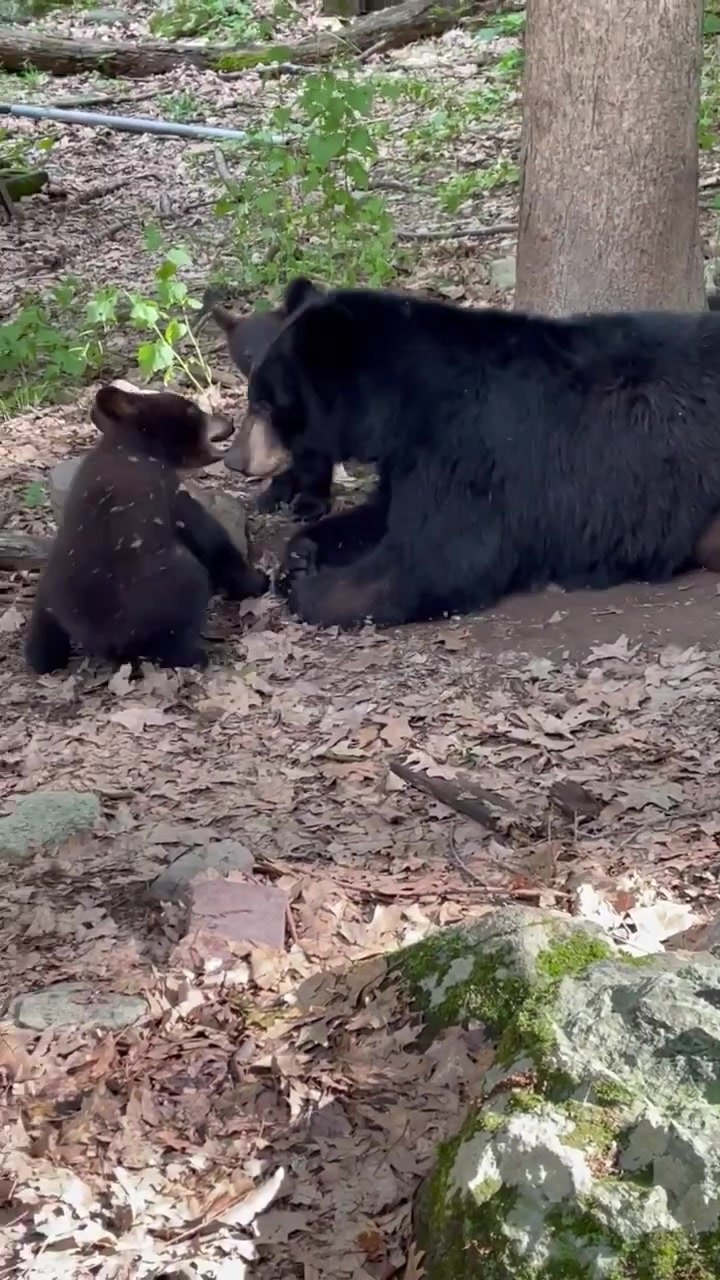
A small black bear cub sits up on dry leaf litter nose to nose with its mother, who lies on her belly with a tan muzzle, a second cub half hidden behind her head, a tree trunk and green seedlings behind.

Footage: ViralHog · 0:39 · uploaded January 9, 2023
Written by My Crittercam · published November 6, 2026

The Story

A sow American black bear lies sprawled in the leaf litter at Highland Lakes, New Jersey, her tan muzzle buried against the head of a cub. A sibling is in the game too, and for the moment the family is one slow knot of black fur.

Out of the blue one cub turns away from his mother and his sibling and walks toward the person filming. He stops short and glances up. There is a hesitation, a very small bear weighing up a very tall human, and then he gently touches a shoe, so close that his head fills the frame. He turns and walks back to his mother, errand complete.

Why he came over, nobody can tell from the footage, but he brings a black bear's best tool to the meeting: a sense of smell exceptionally keen, better than a dog's, held inches from a stranger's shoe.
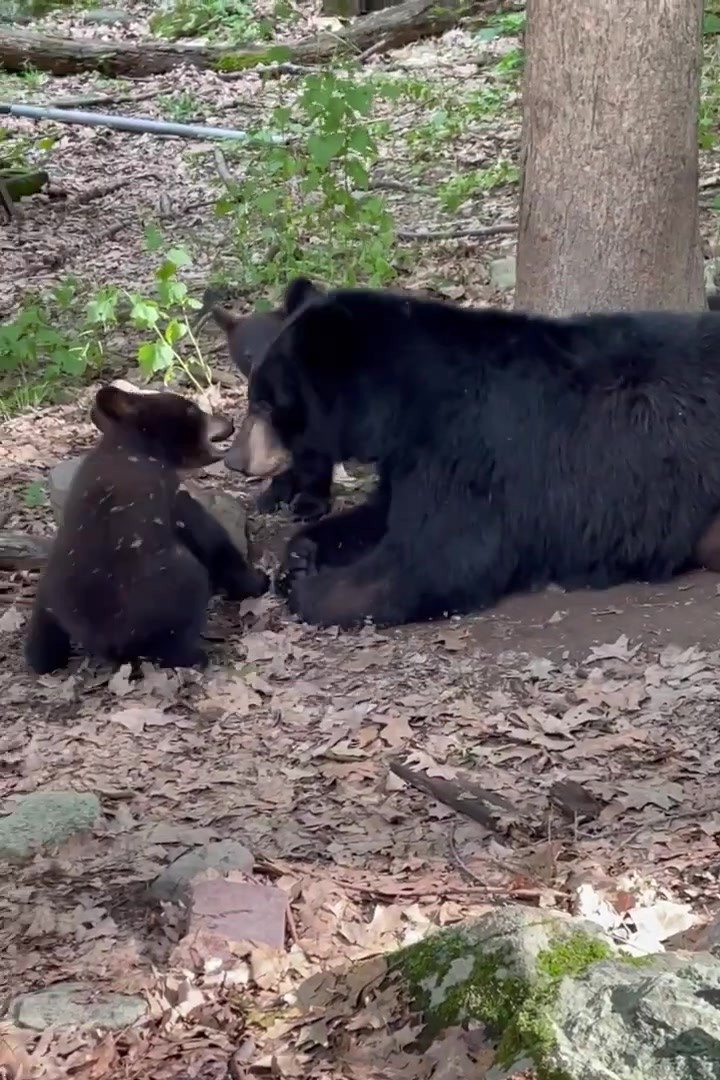
A black bear cub sits up on dry leaves nose to nose with its tan-muzzled mother lying on her belly, a second cub half hidden behind her. A headline runs in white letters across the lower third.Save
Bear cub and mother meet nose to nose

Black bears are normally solitary, and the exceptions are breeding pairs in summer, groups drawn to a feeding site, and a mother with her cubs. Litters run one to five, usually two or three, so a pair of cubs is ordinary arithmetic. They stay with her about 18 months, or until she is ready to mate again.

Black bears are wary of people by nature and not normally aggressive, and attacks are rare. Most bears are only interested in protecting food, cubs or their space, and a cub at a person's feet sits squarely on that list. A sow like this one is large, powerful and surprisingly fast-moving, and she does not charge.

August puts this family in the fruit season. The diet moves from grasses and forbs in spring to shrub and tree fruits in summer, then to nuts and acorns in fall, and to prepare for hibernation a bear can take in 12,000 to 20,000 calories a day. A season of serious eating lies ahead of these cubs, and a winter den after it.
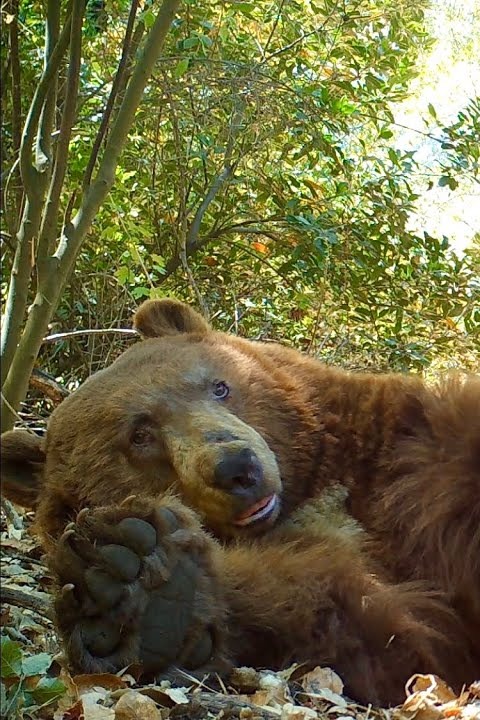
Field Guide

At Highland Lakes, New Jersey, a black bear cub breaks off play with his mother and sibling, walks up to the filmer, touches a shoe and goes back to her. Full field guide for the American black bear

Common nameAmerican black bear
Scientific nameUrsus americanus
FamilyUrsidae (bears)
SizeAbout 3 ft at the shoulder; 5-7 ft standing upright. Total length 1400-2000 mm (males), 1200-1600 mm (females).National Park Service · Animal Diversity Web, University of Michigan
Weight100 to 600 pounds depending on age, sex, and season; males 47-409 kg, females 39-236 kg.National Park Service · Animal Diversity Web, University of Michigan
DietOmnivore: grasses and forbs in spring, fruits in summer, nuts and acorns in fall, plus insects and carrion.Animal Diversity Web, University of Michigan · National Park Service
Active whenGenerally crepuscular (dawn and dusk); breeding and feeding can shift this seasonally.Animal Diversity Web, University of Michigan
RangeNorthern Alaska east across Canada to Labrador and Newfoundland, and south through most of the U.S. into central Mexico.Animal Diversity Web, University of Michigan
LifespanCan live to 30 years in the wild but most often about 10; NPS gives an average of 15-25 years.Animal Diversity Web, University of Michigan · National Park Service
Conservation statusNatureServe: G5 (Globally Secure), reviewed 2016-04-05. IUCN Red List page could not be fetched.NatureServe Explorer
Cam notes · Camerafilmed on foot, close enough for the cub to reach a shoe
Cam notes · Time of dayday
Cam notes · SeasonAugust, late summer
Cam notes · PlaceHighland Lakes, New Jersey, USA

Habitat

Behavior

Questions

Why doesn't the mother bear charge when her cub goes up to a person?

Black bears are by nature wary of people and not normally aggressive, though they are large, powerful and surprisingly fast-moving. Attacks are rare, and most bears are only interested in protecting food, cubs or their space.Minnesota Department of Natural Resources · National Park Service

Is this a black bear or a grizzly?

Compared with grizzlies, black bears have longer, less heavily furred ears, smaller shoulder humps and a convex rather than concave face profile. Their claws rarely grow more than 1 1/2 inches, and colour is no help, since black bears can be black, cinnamon, blonde, blue/gray or even white.Animal Diversity Web, University of Michigan · Alaska Department of Fish and Game · National Park Service

How many cubs does a black bear have?

Litters number one to five cubs, usually two or three. The cubs stay with their mother about 18 months, or until she is ready to mate again.Animal Diversity Web, University of Michigan · National Park Service

Latest clips