My Crittercam
My Crittercam › American bison

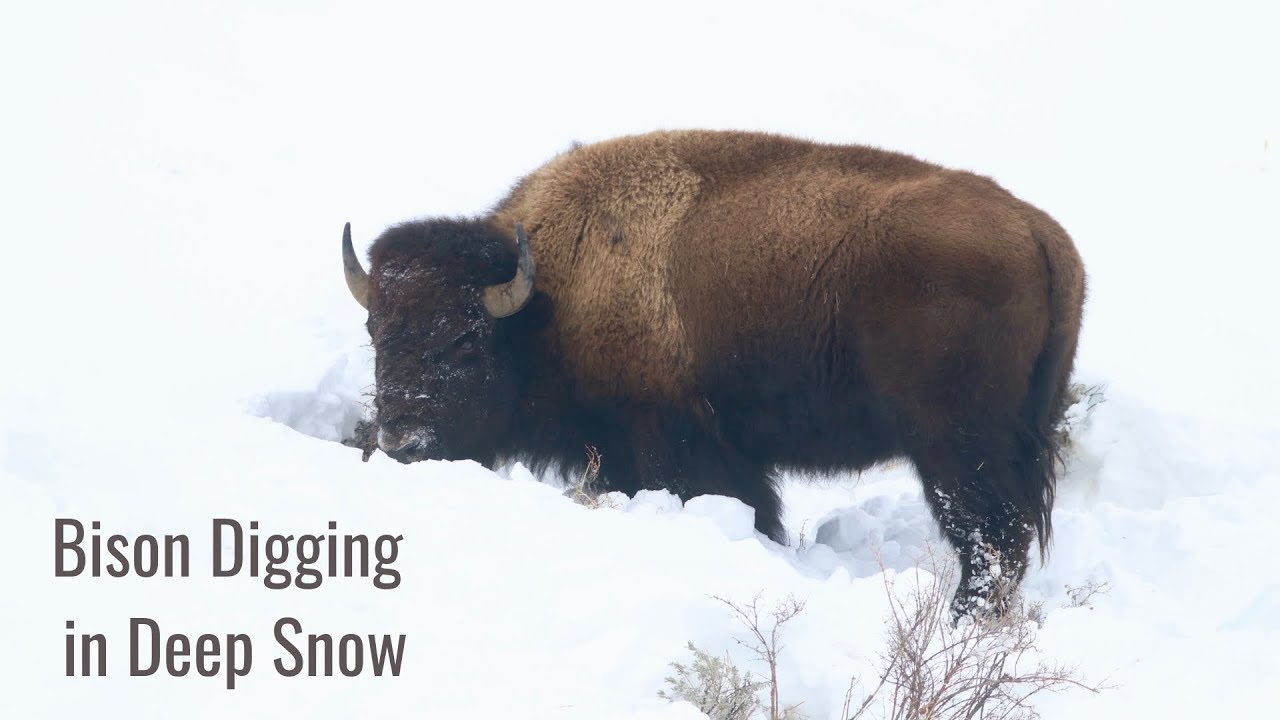
Bison shovels deep snow with its forehead

A dark-faced American bison with short upcurved horns presses its snow-dusted muzzle into a deep drift, its shaggy brown shoulder filling the right edge, with the cut-off words Digging and ep Snow printed at lower left.

Footage: Fy Nyth · 1:38 · uploaded March 20, 2019
Written by My Crittercam · published November 6, 2026

The Story

An American bison stands deep in a Wyoming snowfield with its face pressed into the drift, and it is not grazing so much as excavating. Head low, it drives forward and bulldozes the snow aside.

The forehead does the shoveling, and whatever is edible under the snowpack is the point of the exercise. There is one animal in frame, dark-headed and broad, alone against the white.

Bison are built for this kind of roadwork. The hump over the front shoulders is the giveaway: large shoulder and neck muscles let a bison swing its head side to side to clear snow from a foraging patch. Thick, long, dark hair covers the head and front of the body, so the part of the animal doing the plowing is also the shaggiest. The horns, short and curving out and up, ride above the work. Both sexes carry them, so they settle nothing about whether this is a bull or a cow.

The prize is ordinary. In Yellowstone, more than 90 percent of a bison's diet is grasses, sedges and other grass-like plants, and a bison eats about 1.6 percent of its body mass in dry vegetation every day. A bull can reach 2,000 pounds. Under deep snow, that daily ration has to be uncovered before it can be eaten.

Winter in high country is a margin game. Thick skin and underfur, long guard hairs and layers of fat hold the heat in. Even so, on average 9 of every 100 adult Yellowstone bison die in winter, and 20 to 40 of every 100 first-year animals may die.

Mountain bison once drifted down to lower valleys when snow piled up; herds in the U.S. now move mostly within parks and nearby land. This one has a patch and a plan, and the plan is a forehead-wide trench, one push at a time.
Field Guide

In a deep Wyoming snowfield, a bison plows the drift aside with its forehead to reach food buried under the snowpack. Full field guide for the American bison

Common nameAmerican bison
Scientific nameBison bison
FamilyBovidae (cattle, bison, antelope and goats)
DietYellowstone bison: more than 90% grasses, sedges and other grass-like plants; forbs and browse usually under 5%.National Park Service (Yellowstone National Park)
SizeMature bulls can reach 5.5 to 6.5 ft (1.9 m) at the hump and 9 to 12.5 ft (2.7 to 3.8 m) long; cows are normally 5 ft (1.5 m) high and 7 to 10 ft (2.2 to 3.2 m) long.Smithsonian's National Zoo and Conservation Biology Institute
WeightBulls up to 2,000 pounds; cows up to 1,000 pounds (Yellowstone).National Park Service (Yellowstone National Park)
Active whenPrimarily diurnal, especially early morning and late afternoon, with grazing periods between loafing and ruminating.NatureServe Explorer
RangeOnce Alaska to northern Mexico; now found on private and protected lands in areas of the western United States and Canada.Animal Diversity Web, University of Michigan
Lifespan15 to 20 years in the wild; up to 40 years recorded in captivity.Animal Diversity Web, University of Michigan
Conservation statusIUCN Red List: Near Threatened; NatureServe Global Rank G4. COSEWIC (Canada): Plains Bison Threatened, Wood Bison Special Concern.NatureServe Explorer
Cam notes · Cameravideo by a photographer
Cam notes · Time of dayday
Cam notes · Seasonwinter, deep snow
Cam notes · PlaceWyoming

Habitat

Behavior

Questions

How do bison find enough to eat under deep snow?

They swing their heads side to side to sweep the snow off the grass, powered by the large shoulder and neck muscles of the hump. In Yellowstone more than 90 percent of what they eat is grasses, sedges and other grass-like plants.National Park Service (Yellowstone National Park) · U.S. Department of the Interior

Is this bison a bull or a cow?

Both sexes have short, sharply pointed horns that curve outward and up, so horns alone do not tell them apart. Mature bulls can reach 5.5 to 6.5 feet at the hump and weigh up to 2,000 pounds in Yellowstone, where cows are normally 5 feet high and weigh up to 1,000 pounds.Smithsonian's National Zoo and Conservation Biology Institute · National Park Service (Yellowstone National Park)

How do such big animals survive a long mountain winter?

Thick skin and underfur, long guard hairs and layers of fat insulate them through the cold. Winter still takes a toll: in Yellowstone on average 9 of 100 adults die each winter, and 20 to 40 of 100 first-year animals may die.National Park Service (Yellowstone National Park)

Latest clips