The Story
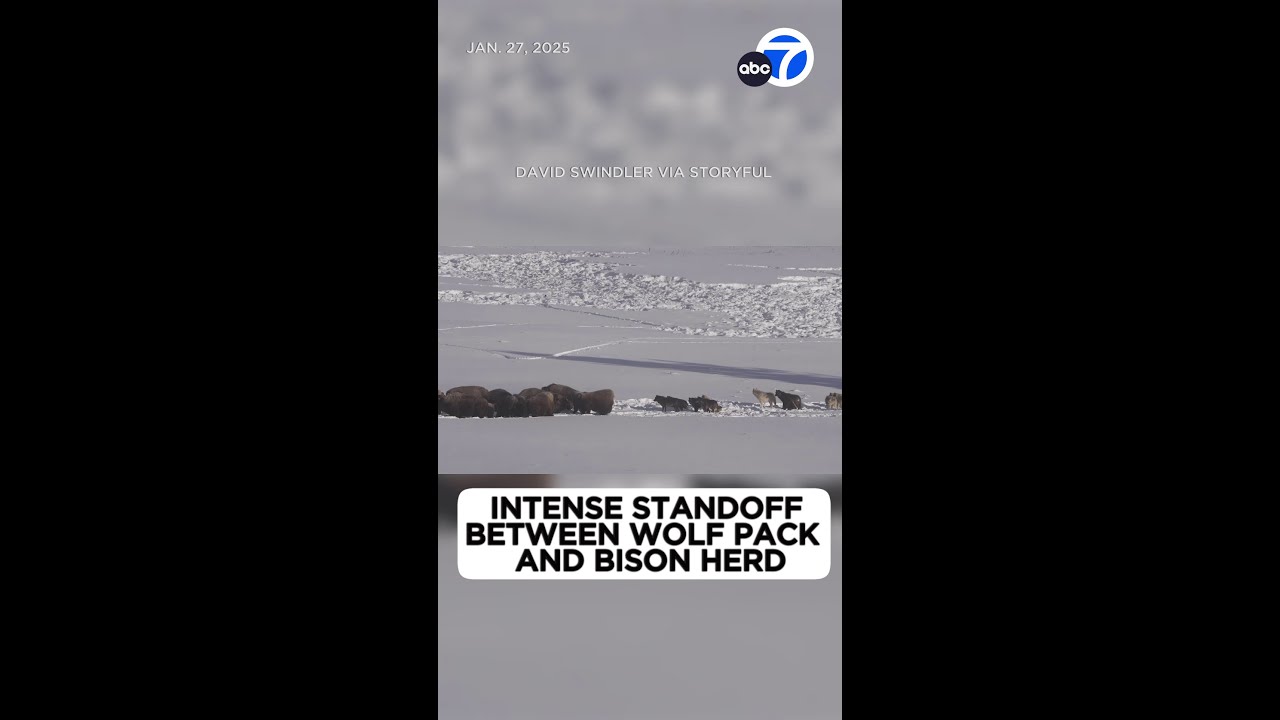
On open snow in Yellowstone's Hayden Valley, a herd of American bison stands bunched into one dark block while a pack of gray wolves fans out in a loose line beside it. It is late January, and the wolves are waiting.
The herd is working to protect several calves, and in the frame it holds together as a single mass on the flat, no animal standing apart. Behind them a band of broken snow runs across the valley under flat grey light.
Calves are the point. Wolves and mountain lions prey on elderly, ill bison and calves. The adults are another proposition. A Yellowstone bull can weigh up to 2,000 pounds and a cow up to 1,000, while a male wolf here averages about 110. Bison can run up to 35 miles per hour and spin around quickly. The numbers explain the patience.
Winter tilts the odds. Bison calves are born in late April or May, so these are last spring's young, and calves turn entirely brown by four months. In the still frame none stands out from the adults. The season is when that age class pays: in Yellowstone, 20 to 40 of every 100 first-year bison may die over a winter, against an average of 9 of 100 adults.
The pack has its own arithmetic. Bison are on the gray wolf's menu in the Rockies, but in Yellowstone elk make up more than 96 percent of winter prey. Wolves trot at about 5 miles an hour and can reach 40, and their big feet work like snowshoes. A bison clears snow by swinging its head side to side, powered by the big shoulder and neck muscles that form the hump.
Bison have an excellent sense of smell and hearing. Against the cold they carry thick skin and underfur, long guard hairs and layers of fat, insulation that lets a herd stand on a Wyoming snowfield in January. The clip ends without showing how the standoff resolves.