The Story
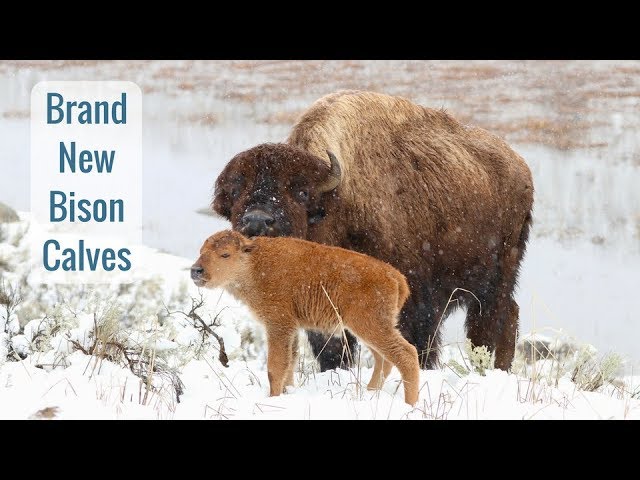
Snow is coming down on open ground in Yellowstone, and a reddish-brown American bison calf stands in it on legs that still look borrowed. Its mother stands at its back, broad and dark against the white.
It is one of two very new calves here, among the first born that spring. One of the pair may have arrived earlier that same day, and it is the quieter of the two. Both wobble when they move, and both nurse. The ground had been green before the storm; spring had been declared a little early.
The timing is normal for bison. A cow carries a single calf for 9 to 9½ months and gives birth in late April or May. The newborn's red coat is a phase: it begins turning brown at about two and a half months and is gone by four. A calf can keep up with the herd two to three hours after birth, then nurses for seven to eight months.
The mothers have the harder job. Milk has to come from somewhere, and the grass is now buried, so they stay close to the calves while working for food under the fresh snow. In Yellowstone, more than 90 percent of a bison's diet is grasses, sedges and grass-like plants. Large shoulder and neck muscles let bison swing their heads side to side to clear a patch.
Later the footage turns to a bigger herd crossing an open field. These animals paw through the snow and graze as they go, keeping together, with a few sandhill cranes nearby. No new calves show among them. Bison herds keep a linear pecking order, and when they travel they string out in a line led by an adult cow.
The stakes for the two newborns are real. Wolves and mountain lions take calves, and in Yellowstone 20 to 40 of every 100 first-year bison may die in winter. These two have a summer to grow first. For now they have a mother, a meal and a coat the color of rust.