Coyote field guide
Field Guide
| Common name | Coyote |
|---|---|
| Scientific name | Canis latrans |
| Family | Canidae (Dogs, wolves, foxes and jackals) |
| Size | Length 75 to 100 cm; 16-20 inches high at the shoulder (Yellowstone); eastern coyote 4 to 5 feet nose to tailAnimal Diversity Web, University of Michigan · National Park Service · New York State Department of Environmental Conservation |
| Weight | 7 to 21 kg; 25-35 pounds in Yellowstone; eastern coyote 35 to 45 poundsAnimal Diversity Web, University of Michigan · National Park Service · New York State Department of Environmental Conservation |
| Lifespan | In Yellowstone: average life span 6 years, up to 13 yearsNational Park Service |
| Diet | About 90% mammals: voles, mice, rabbits, squirrels, plus deer, carrion, birds, insects and fruitAnimal Diversity Web, University of Michigan · National Park Service · New York State Department of Environmental Conservation |
| Active when | Essentially nocturnal; more active after sunset and at night, but may be seen moving about during the dayAnimal Diversity Web, University of Michigan · New York State Department of Environmental Conservation |
| Range | Alaska and Canada south through the US and Mexico to Central America; expanded into the eastern USAnimal Diversity Web, University of Michigan · NatureServe Explorer |
| Conservation status | IUCN Red List: Least Concern; NatureServe: G5NatureServe Explorer |
Field Marks
- About one-third the size of a gray wolf, with a slighter build.National Park Service
- Eastern coyotes are told from wolves by smaller size, large pointed ears and a pointed snout.New York State Department of Environmental Conservation
- Runs with the tail down; domestic dogs run with tails up and wolves with tails straight out.National Park Service
- Bottle-shaped tail about half the body length, with a black tip.Animal Diversity Web, University of Michigan
- Shorter, bushier tail carried low, almost dragging the ground, and a longer, narrower muzzle than a dog.Washington Department of Fish and Wildlife
- Coat varies from blonde or reddish blonde to dark tan washed with black; legs, ears and cheeks usually reddish.New York State Department of Environmental Conservation
Habitat
- Uses forests, grasslands, deserts and swamps, as well as suburban, agricultural and urban settings.Animal Diversity Web, University of Michigan
- In Yellowstone it is seen in meadows, fields and other grasslands, and foraging for small mammals along roadways.National Park Service
- In Washington it lives in many urban and suburban parks, greenbelts and other wooded spaces.Washington Department of Fish and Wildlife
- Trails often follow draws, fence lines, game and livestock trails, road edges, dirt roads and ridge tops.Washington Department of Fish and Wildlife
- It often enlarges woodchuck or badger burrows for its dens, and dens are used year after year.Animal Diversity Web, University of Michigan
- Home range in Yellowstone is 3-15 square miles.National Park Service
Behavior
- Hunting mice, it stalks slowly through grass and sniffs out the mouse, then stiffens and pounces with all four legs held together.Animal Diversity Web, University of Michigan
- Called the most vocal of all North American wild mammals: a quick series of yelps followed by a falsetto howl.Animal Diversity Web, University of Michigan
- Woofs and growls are short-distance threat and alarm calls; barks and bark-howls are long-distance ones; lone and group howls pass between separated group members when food has been found.Washington Department of Fish and Wildlife
- A howl lets other pack members know where the coyote is. Howling is heard especially at dawn and dusk.National Park Service · National Park Service
- Eastern coyotes howl all year but are highly vocal from late summer through early fall, and again during the winter breeding season.New York State Department of Environmental Conservation
- Less likely to form packs than wolves; hunts alone, in pairs or in family units.Animal Diversity Web, University of Michigan
- Cook County packs are usually an alpha male and female plus a few others; in protected habitats a group is typically five to six adults besides that year's pups.Urban Coyote Research Project (Cook County, Illinois)
- Cook County pack territories show very little overlap. In that Chicago-area study, one-third to one-half of the coyotes studied each year were solitary, travelling up to 60 square miles.Urban Coyote Research Project (Cook County, Illinois)
- Pairs are monogamous and may stay together a number of years, but not necessarily for life.Animal Diversity Web, University of Michigan
- Mating runs January to March; gestation is 60 to 63 days.Animal Diversity Web, University of Michigan
- In Yellowstone, 4-8 pups are born in dens in April and emerge in May.National Park Service
- Eastern coyote pups in New York are weaned at 5 to 7 weeks and fully grown at 9 months.New York State Department of Environmental Conservation
- In a Chicago-area study of 1,429 scats, the most common items were small rodents 42%, fruit 23%, deer 22% and rabbit 18%.Urban Coyote Research Project (Cook County, Illinois)
- Vehicle collisions are the most common cause of death for coyotes in the Chicago-area study: 40 to 70% of deaths each year.Urban Coyote Research Project (Cook County, Illinois)
Winter
- In snow it walks a meadow listening for small mammals moving under the snow, then leaps and dives face first to catch them.National Park Service, Yosemite National Park
- Breeding season falls in winter (January to March), when howling choruses pick up again.Animal Diversity Web, University of Michigan · New York State Department of Environmental Conservation
- It molts once a year, starting in May and ending in July.Animal Diversity Web, University of Michigan
Questions
How big is a coyote?
In Washington, adults weigh 20 to 35 pounds and an adult male stands about 25 inches at the shoulder; Yellowstone coyotes weigh 25 to 35 pounds and stand 16 to 20 inches. Eastern coyotes are larger, 35 to 45 pounds.National Park Service · Washington Department of Fish and Wildlife · New York State Department of Environmental Conservation
Is it a coyote or a wolf?
A coyote is about one-third a wolf's size, with large pointed ears and a pointed snout. Coyotes run with the tail down; wolves hold it straight out.National Park Service · New York State Department of Environmental Conservation · National Park Service
Are coyotes dangerous to people?
Attacks are rare: a search of US and Canada records from 1985 to 2006 found 142 attack incidents (bites) with 159 victims, and only two fatal attacks are recorded in the US and Canada in modern history. In almost a third of cases, coyotes were known to be fed near the site.Urban Coyote Research Project (Cook County, Illinois)
Will a coyote go after my dog or cat?
Cats and small to mid-size dogs left outside at night in an unprotected area may be killed. Chicago-area newspaper records show 70 attacks on dogs and 10 on cats, with small dog breeds attacked more often than larger ones.Washington Department of Fish and Wildlife · Urban Coyote Research Project (Cook County, Illinois)
What should I do if a coyote comes close?
Haze it: make loud noises, wave sticks or squirt it with a hose. Never feed coyotes, so they keep their natural fear of people.Washington Department of Fish and Wildlife · New York State Department of Environmental Conservation
Why do coyotes dive into the snow?
They listen for small mammals moving under the snow and pinpoint the spot. Then they leap into the air and come down face first into the snow to catch it.National Park Service, Yosemite National Park
What do coyotes eat?
About 90% of the diet is mammals, mainly small ones such as cottontail rabbits, ground squirrels and mice. They also eat carrion, birds, snakes, insects and fruit.Animal Diversity Web, University of Michigan
Why are coyotes out in the daytime?
Coyotes are not strictly nocturnal; they are more active after sunset and at night. In Rocky Mountain National Park they are spotted frequently during the daytime.New York State Department of Environmental Conservation · National Park Service
Where do coyotes sleep and raise pups?
Pups are born in dens, often enlarged woodchuck or badger burrows that are used year after year. In Yellowstone pups are born in April and come out in May.Animal Diversity Web, University of Michigan · National Park Service
How long do coyotes live?
In Yellowstone the average life span is 6 years. Some reach 13 years.National Park Service
Clips
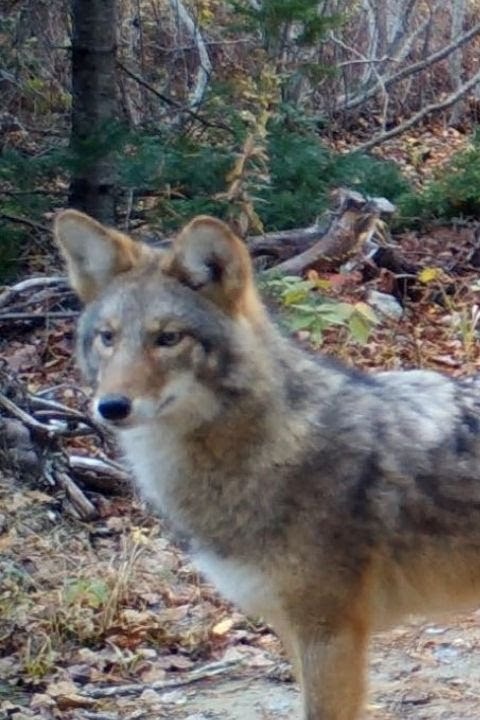 Sideways stare from a coyote on a Maine trail
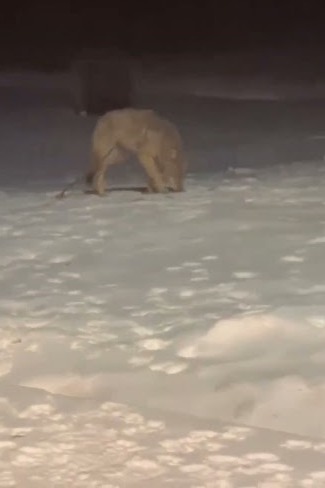 Backyard coyote mistaken for a wolf in the snow
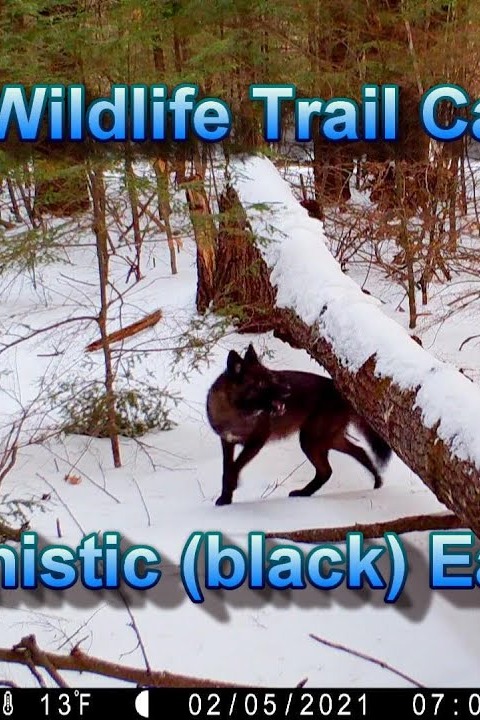 Black eastern coyote by a snowy log in Maine
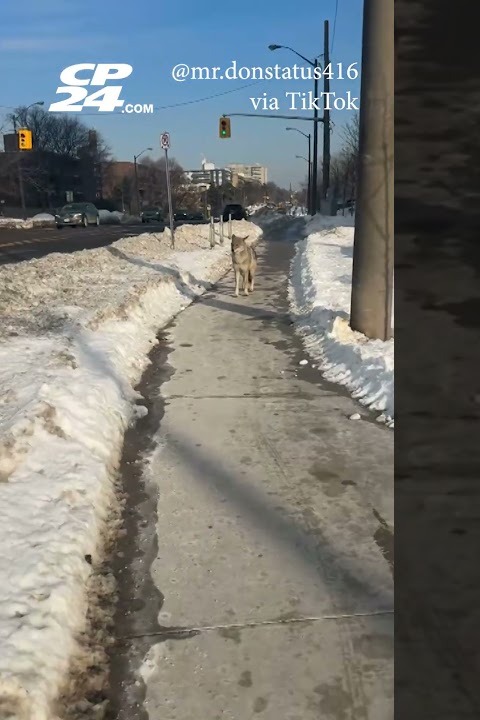 Coyote walks a Toronto sidewalk toward a man
On a Penobscot County trail in fall color, a coyote stands broadside in daylight with its face turned to a fixed trail camera.
In a snowy backyard at night, a coyote the family took for a wolf noses the ground where their dogs had been playing, then leaves with the dogs' toy.
A melanistic eastern coyote, judged a young female by the filmer, walks past a skunk-scented fallen log in the snowy Maine woods.
A lone coyote walks a plowed sidewalk near York Mills and the Don Valley Parkway in Toronto in broad winter daylight, straight toward a man who shouts it off.
Sources
- Canis latrans (coyote), Animal Diversity Web, University of Michigan
- Coyote - Yellowstone National Park, National Park Service
- Eastern Coyote, New York State Department of Environmental Conservation
- Coyote (Canis latrans), Washington Department of Fish and Wildlife
- Coyote - Rocky Mountain National Park, National Park Service
- General Information About Coyotes, Urban Coyote Research Project (Cook County, Illinois)
- Canis latrans, NatureServe Explorer
- Coyote (ranger note), National Park Service, Yosemite National Park
- Conflicts: A Research Perspective, Urban Coyote Research Project (Cook County, Illinois)